

This article was produced through the Healing Illinois: Democracy Lives Here Reporting Project with the Medill Solutions Journalism Hub at Northwestern University. Healing Illinois — an Illinois Department of Human Services initiative managed with the Field Foundation — supports storytelling and community collaborations to address racial and systemic inequities across the state.
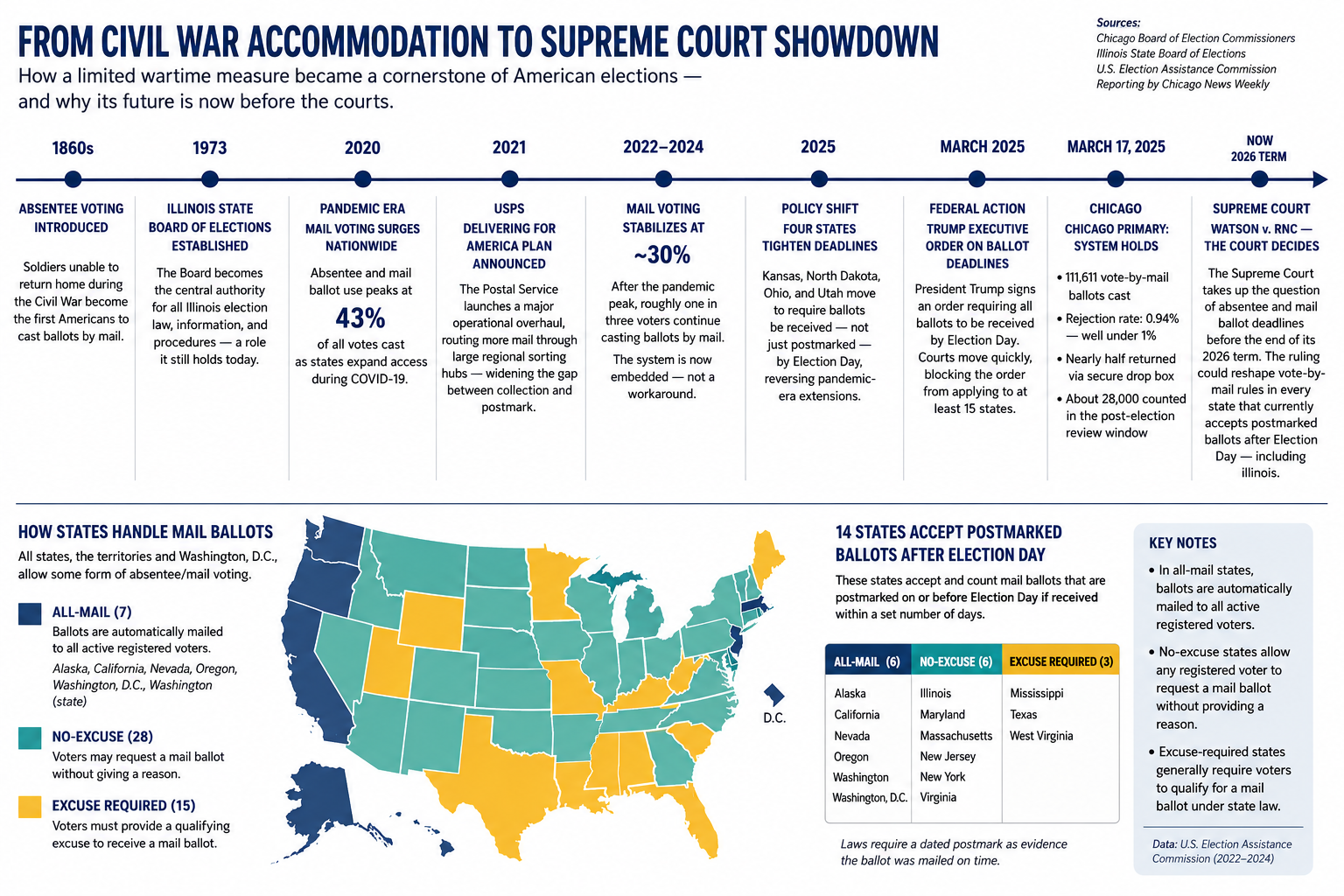
Vote-by-mail did not begin as a pandemic-era workaround. Its roots stretch back to the Civil War, when absentee voting was first introduced to allow soldiers to cast ballots while away from home. Over time, what began as a limited accommodation evolved into a central part of American election administration.
Today, vote-by-mail is no longer a temporary expansion of the electoral system. It is a durable, widely used method that continues to shape how elections are conducted at every level. In the 2024 presidential election, roughly 30 percent of voters cast ballots by mail, according to the U.S. Election Assistance Commission, reflecting sustained use even after the pandemic-era surge. The United States Postal Service reported processing more than 99 million ballots during the election, underscoring the scale at which the system now operates.
In Illinois, where vote-by-mail is available without excuse, that reliance remains significant. In Chicago’s March 17 primary, more than a quarter of all ballots—26.29 percent—were cast through vote-by-mail, according to the Chicago Board of Election Commissioners. Of the 111,611 ballots cast by mail, nearly half were returned through secure drop boxes rather than through the postal system. So what changes have been made?
Statewide data shows that vote-by-mail continued to function at a high rate. Across Illinois, 860,002 vote-by-mail ballots were returned, 831,744 were counted and 28,258 were rejected. That places the statewide vote-by-mail rejection rate at approximately 3.29 percent, meaning nearly 97 percent of returned mail ballots were counted.
Over the past several months, Chicago News Weekly has examined how vote-by-mail is functioning in practice—analyzing local election data, reviewing policy changes, and speaking with election officials, postal representatives, and community organizations. The reporting focused on a central question: as mail voting becomes embedded in the system, what happens when the systems that support it evolve?
That question is not abstract. For voters like our managing editor’s grandparents, now 90 and 92, voting has never been a casual act. It is a ritual shaped by history, privilege, access, and persistence. They came of age in a country where full participation in democracy was not always guaranteed, yet they have voted consistently for decades. For them, a mail in ballot is not simply a convenience. It is a continuation of a right that was once contested, won and is still, in many ways, being negotiated.
Older Americans are among the most consistent voters in the country, with turnout rates exceeding 70 percent in recent national elections. They are also among the voters most likely to rely on vote-by-mail, a system now used by roughly one in three voters nationwide. In the context of U.S. election statistics, "older voters" generally refers to citizens aged 65 and older. For some voters, mail voting is not merely a convenience. It is the most practical path to participation.
Older voters are not a side audience in this debate. They are among the country’s most consistent voters, and many rely on vote-by-mail because of age, mobility, disability, transportation, caregiving needs or health-related barriers.
That is where the equity question begins. When ballot timelines depend on postal processing, voter education, transportation, drop boxes or the ability to visit a post office counter, the burden does not fall evenly across the electorate. A change that may be manageable for one voter can become a barrier for another. For seniors, voters with disabilities, homebound residents, shift workers, caregivers and voters with limited transportation, the ability to adapt cannot be assumed.
A quiet but consequential shift inside the United States Postal Service is reshaping how time is measured in the voting process—and raising new questions about whether election systems have kept pace with how mail actually moves.
The Postal Service maintains that its postmarking practices have not changed. In a statement provided by Tim Norman, the agency said postmarks have long been applied at originating processing facilities rather than at the point of collection and will continue to be applied at those facilities in the same manner and to the same extent as before. Postmarks applied at those facilities continue to contain the name or location of the facility that applied the postmark and the date on which the first automated processing operation was performed on that mailpiece.
Postmarks are often treated as a proxy when a ballot is mailed. But as the Postal Service explained, they have never functioned that way.
At the same time, the agency acknowledged a shift that is less visible but more consequential. Adjustments to its transportation operations may result in some mailpieces not arriving at originating processing facilities on the same day they are mailed. Because postmarks are generally applied at those processing facilities, the date on the postmark may not necessarily match the date on which the mailpiece was collected by a letter carrier, dropped off at a retail location or placed in a collection box.
“Because postmarks are generally applied at those processing facilities, this means that the date on the postmark may not necessarily match the date on which the mail piece was collected,” Norman said.
The Postal Service also emphasized that what has changed is not the application of postmarks, but how mail moves through its system. Transportation adjustments may result in mail being processed on a different timeline than when it is collected, meaning postmarks reflect processing, not pickup. The agency framed the clarification as an effort to improve public understanding of how postmarks function, noting that third parties often rely on them in ways that extend beyond their original purpose.
In practical terms, that creates a gap between voter action and system recognition—a gap that voters cannot see and cannot control.
The Postal Service said the changes are designed to “eliminate inefficiencies and ensure a reliable integrated mail and package network.” First-Class Mail, including ballots, continues to operate within a one- to five-day delivery standard.
The practical concern is not whether the Postal Service applies postmarks. It is when that postmark is applied and whether the date reflects the voter’s action in time to satisfy election rules. A voter may believe a ballot has been mailed on time because it was placed in a mailbox or dropped at a post office before the deadline. But if the postmark reflects processing rather than collection, the system may record a different date than the one the voter experienced.
USPS says voters can reduce that risk by mailing ballots before Election Day and at least one week before the deadline by which the completed ballot must be received by the election office. Voters who want to ensure that their ballot receives a postmark, and that the postmark reflects the day it is mailed, can visit a Postal Service retail counter and request a free manual postmark. Special attention should be given for Illinois/Chicago mail in ballot voters because of the city’s noted mail delays.
Those recommendations are clear, but they also shift part of the responsibility onto the voter. The system may still work, but it works best for voters who know the rules early, have time to act and can physically reach the options designed to protect them.
In Chicago, the first major election cycle under these conditions offers an early test of whether those timing shifts translated into measurable impact. They did not, at least not in the form of widespread ballot rejection.
Data from the Chicago Board of Election Commissioners shows that of the 111,611 vote-by-mail ballots cast in the March 17 primary; 1,046 were rejected, including those with late or insufficient postmarks. That represents 0.94 percent of ballots cast. They make a difference.
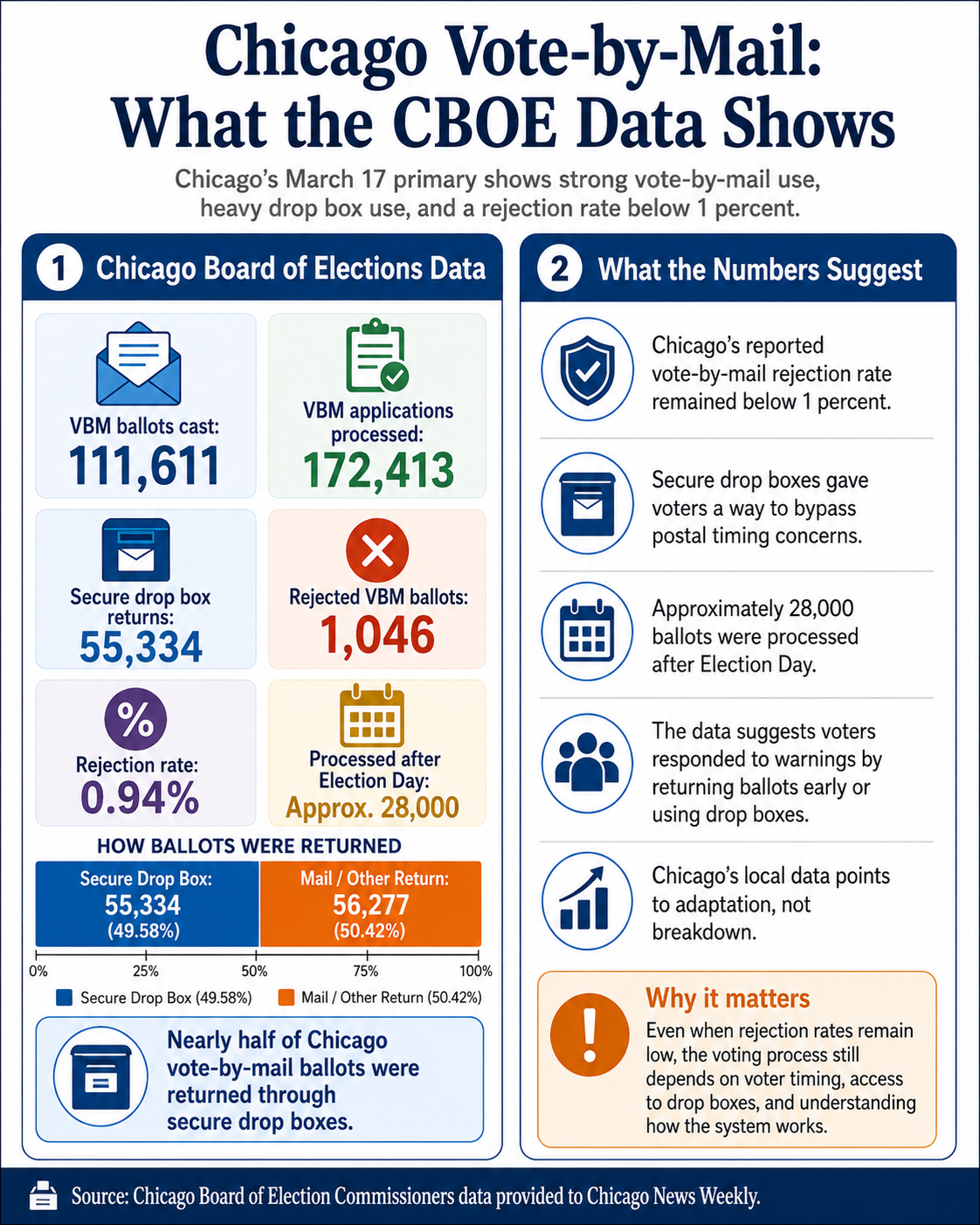
The Board also reported 172,413 total vote-by-mail applications processed, a 64.73 percent successful return rate. In the same primary, Chicago saw 424,564 total ballots cast, a 27.30 percent citywide turnout among 1,555,301 active registered voters. Vote-by-mail represented 26.29 percent of all ballots cast.
That figure gives Chicago a concrete local baseline. The city’s vote-by-mail rejection rate remained under 1 percent, even as questions about postal timing grew more urgent. The number does not erase the risk, but it shows that widespread rejection did not materialize in this election cycle.
Statewide, Illinois also reported a low rejection rate. The state vote-by-mail report shows 860,002 ballots returned, 831,744 counted and 28,258 rejected, a rejection rate of approximately 3.29 percent. The data points in two directions at once: vote-by-mail is still counting the overwhelming majority of returned ballots, but the ballots that are rejected still represent voters who completed the process and did not have their votes counted.
At a system level, those numbers suggest stability. They also point to adaptation. Nearly half of all vote-by-mail ballots—55,334—were returned through secure drop boxes rather than through the mail.
“Voters seemed to have heeded the many warnings and got their ballots back early, either through the mail or at a Secure Drop Box location,” said Max Bever of the Chicago Board of Elections. “In fact, nearly half of Chicago vote-by-mail voters used a Secure Drop Box.”

The Board also reported that approximately 28,000 ballots were counted after Election Day within Illinois’ 14-day review window, which allows ballots postmarked by Election Day to be counted even if they arrive later.
“All in all, we were pleased to see that voting by mail remained a popular and uninterrupted option for voters,” Bever said.
The data points in two directions at once. On one hand, Illinois’ statewide rejection rate remained low, with approximately 3.29 percent of returned vote-by-mail ballots rejected. In Chicago, the rate reported by the Board of Elections was lower, at 0.94 percent. Those numbers suggest that vote-by-mail remains a stable and widely used voting method. On the other hand, USPS’ own explanation makes clear that the date a ballot is collected and the date it is postmarked may not always be the same. That difference may affect only a small share of ballots, but for the voter whose ballot falls into that gap, the consequence can be total.
The clearest response was not one single fix, but a layered system of protection. Illinois’ post-election review period gave eligible ballots time to arrive after Election Day. Secure drop boxes reduced reliance on postal timing altogether. Early-return warnings from election officials pushed voters to act before the deadline. USPS guidance, including mailing ballots at least one week early or requesting a manual postmark, gave voters additional ways to reduce risk.
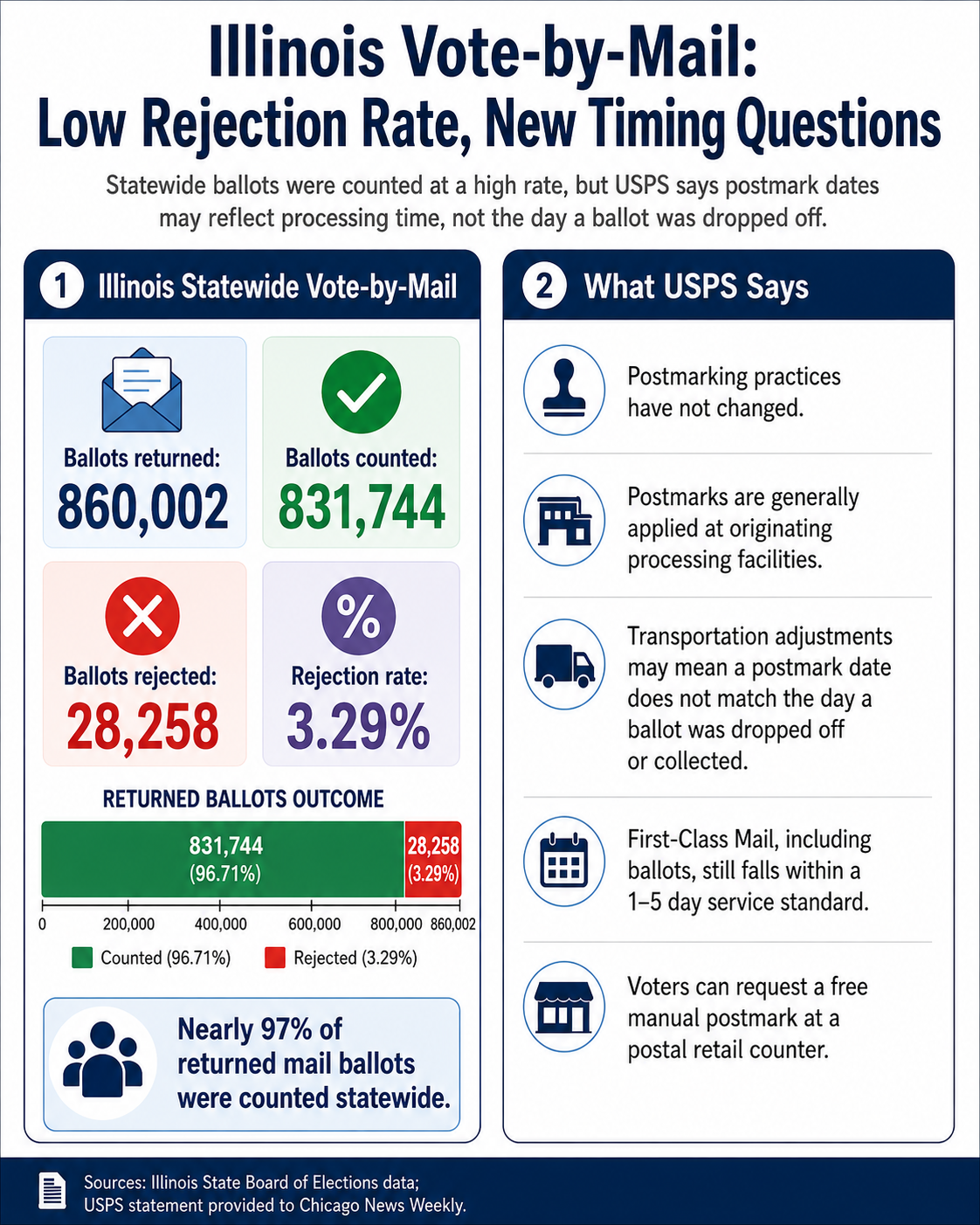
The numbers suggest those safeguards mattered. Statewide, 831,744 of 860,002 returned vote-by-mail ballots were counted. In Chicago, nearly half of vote-by-mail ballots were returned through secure drop boxes, and approximately 28,000 ballots were processed after Election Day. The system did not collapse under the weight of postal timing questions. It adapted.
But adaptation is not the same as ease. If voters have to mail earlier, request a manual postmark, use a drop box or rely on a post-election review period, then the process depends not only on election law, but on voter knowledge, mobility and timing. That is where a low rejection rate can still reveal an access problem.
That is the transferable lesson. If even a slight change in voter behavior determines whether a ballot is mailed, dropped, counted or rejected, then the system is no longer operating independently of its users. It is operating in response to them.
When we sat down to talk with Matt Dietrich, Public Information Officer, Illinois State Board of Elections, he was a breath of fresh air. He was so self-assured that they were on top of the challenge they face for the upcoming Illinois Primary to manage the process of disseminating information to the people. Since 1973, the Board's purpose has been to serve as the central authority for all Illinois election law, information and procedures in Ill. So, Matt Dietrich excitedly spoke very candidly providing insight as to what the Illinois State Board of Elections does and how.

“Oh we’re ready!’ He says, “In the event that the Supreme Court were to rule that all vote by mail ballots must arrive by election day to be counted, we know that that's going to entail a lot of voter education. So we've already been in contact with the Illinois Broadcasters Association about launching a television and radio ad campaign that would begin as quickly after the decision is issued as possible, and we're also aware that we would need to work with the local election authorities to help them get some messaging out to their voters to let them know that the rules have changed for when you can send in your vote by mail ballot, for a lot of voters in Illinois, it's going to mean that if you're going to use the mail to return your ballot, you need to get that into the mail at least a week ahead of Election Day to give it plenty of time to get to your local election authorities office so that they can open it and record your vote by election day, no later than Election Day.
Matt responded, “Well, all of that would come into play, and when you talk about things like that, you're probably getting into some regional differences.
“We've talked about this. We are very much aware that in the city of Chicago, and in the suburbs, mail delays are very common, and it can take a lot longer for mail, even if it's sent within Chicago or within Cook County, to arrive at the Chicago Board of Elections or arrive at the Cook County Clerk's Office. It may take longer than, say, in a downstate jurisdiction where you may be looking at just a day or two between when you either hand your ballot to your letter carrier or put it into a mailbox or take it to a post office and drop it off. He continues, “The local election authorities will do a lot of the necessary messaging with their specific voters. And a lot of what is going to happen at the time that you receive your ballot is going to require updating information. It's probably going to have a pretty prominent notice to you as a voter that, hey, the rule has changed on how your ballot can be received, and when, and counted. So voters must get this. It must be received by your election authority no later than Election Day in order for your ballot to be counted.
It’s imperative that you have this information, according to Mr. Dietrich, “So I would assume you're going to see very prominent messaging from the local election authorities to their voters when they send those ballots out, and also probably at the time of application. You're going to see things on their websites when voters apply for their vote by mail ballots. Therefore, it’s my assumption that a lot of the messaging is going to come from the county clerks, from the local boards of election, like the Chicago Board of Elections, directly to the voters, in addition to what we may be doing. And you'll probably see separate mailings on this as well. As the election authorities we work to get the message out to voters about any and all new rule changes. However again, at this point we don't know what those changes are. so, our current rules are still in effect until the Supreme Court says otherwise.
Looking as if he just put on a different ‘thinking cap’, He says, “The other thing that may happen, because there is some precedent for this, that the courts generally are reluctant to make these kinds of changes in the middle of an election cycle, when it might interfere with the current process. Yes. so, you could get a decision from the Supreme Court that says, after the November 3 election, in all elections going forward this is what the rule is, and state what the change is and when it will be implemented.” That's a possibility, but we just don't know at this time.”
“Therefore we don't want to put out any messaging that is going to confuse voters, and because a lot of people don't even know this is going on. After all these years of telling voters that number one, if you're voting by mail, you need to make sure it gets there within 14 days after Election Day, but it's got to be postmarked by election day. And we've also been telling voters, hey, those vote totals that you see on election night are probably going to change in the two weeks after election day.” Dietrich made it clear that if the Supreme Court rules for the plaintiffs in Watson the RNC, then what you will see on election night is basically what the outcome will be.”
The point Mr. Dietrich drives is that with the changes come huge distinctions though they may seem to be few and uncomplicated they are not minor in impact and determining the outcome of an election. The cost is huge so it’s critical to get the change in information out clearly and in a timely manner.”
Dietrich noted that Illinois has a 14 days after the election allowing the votes to be counted. and it's been that way, for decades. I don't know exactly when that 14-day period was established, but it had always been premised on a desire to allow military votes enough time to make it back to Illinois.”
About that he provides clarity, “Uniformed and Overseas civilians, Absentee Voting Act, is the formal acronym, and that covers, the process by which they can have ballots emailed to them for quicker delivery, and then they can print and mark those ballots. They have to mail them back physically. There’s a system that, manages and maintains a local voter registration. So, if you're in the military, or if you are a US citizen who is living overseas, you would use your last permanent address in the United States as your voting address which falls under the Absentee Voting Act. For example, if you lived in Chicago, prior to your deployment and or living overseas as a civilian, you would use your old address, and then your voting record would be maintained by the Chicago Board of election commissioners, which would send you your absentee ballot. Once you receive and vote you then you send it back to them.”
We talked about the home bound , which includes the elderly or the sickly, and those convalescing in a nursing home for example, who still desire to vote,are each undefined differently.
Mr. Dietrich explained, “That's covered in the Illinois election code. And there is a section of the statutes in the Illinois election code that governs how local election authorities, whether they're county clerks or municipal boards of election, coordinate with nursing homes. They actually have representatives who go in and manage the voting on their premises, then mange the collection of the votes by mail ballots. So that's a system that each office designs in their own jurisdiction.”
Finally, we inquired , “What about those elderly who live alone and or may not be physically able to leave the house to go vote or stand in line? Dietrich had shared the harsh fact that they would have to depend on their family, friends or neighbors to assist them.
In a lot of cases, traditionally, people in that situation might have simply handed their ballot to their letter carrier, to their postal carrier, and if in the event we would have a change to the vote by mail deadline, like where those ballots must be specifically delivered by said deadline, you know as a voter, you must identify someone in your neighborhood to assist you in delivering your ballot. If you know someone who may need your help, you may want to check on them and make sure they have a way to get their ballot dropped off at a secure Drop Box location.
Dietrich pauses, “That’s a whole other thing that we will be encouraging. We always urge people to use that as an option, because it's a direct drop off and return it directly to your election authority. If you do that, it's not going through the mail system or any third-party area. We will most likely be especially encouraging of that option.”
He continues, “If you're concerned about a delay, in getting your ballot to your election authority by election day, traditionally, we've always encouraged people to informally check on family, friends and neighbors. If you have someone in your apartment building who you know, has limited mobility or limited access to the outside. Ask them if you can help. There's a section with directions on the return envelope for vote by mail ballots. If you're going to have someone return mail in ballot, for you, allowing the voter to sign an authorization, where the voter provides said person's name. That individual signs the the mail-in ballot envelop and delivers the ballot. The ballot will be dropped off at the office or they can drop it off at a secure drop box.” Dietrich continues, “The election code doesn't address the issue of having someone else deliver your ballot specifically. However it's required that that you have them fill out the same section on your envelope as you the voter signs,. Finally, it doesn't hurt to fill that section out , if someone's going to deliver it on your behalf.”
Solutions are only as effective as their reach. For many voters, the adjustments that helped maintain low rejection rates are accessible. For others, they are not. Older adults, people with disabilities and voters who are homebound often rely on vote-by-mail as their primary method of participation. In those cases, adapting to changing timelines or accessing alternative return methods is not guaranteed.
A 3.29 percent statewide rejection rate is low in the aggregate, but rejected ballots are not abstract. They represent voters who completed the process but still did not have their ballots counted. The question is not whether vote-by-mail works for most voters. The data suggests that it does. The question is who remains most vulnerable when the process depends on timing, transportation, instructions and access to alternatives.
A drop box is only useful to a voter who can get to it. A manual postmark is only useful to a voter who can visit a post office counter. Mailing a ballot a week early is only useful to a voter who receives, completes and returns the ballot with enough time to spare. For voters who are older, disabled, homebound, working irregular hours, dependent on caregivers or without reliable transportation, those steps are not equally simple.
‘Equip for Equality,’ an Illinois disability rights organization, adds another layer to that concern. For voters with disabilities, the question is not simply whether vote-by-mail exists. It is whether the entire process is accessible from start to finish. Some voters with print disabilities can receive, mark and certify ballots electronically, but they still cannot return those ballots electronically. The final step still requires printing and physical return, whether by mail, delivery or another authorized method.
That gap matters because it shows where accessibility stops short. A voter may be able to read and mark a ballot independently, but still need help printing it, signing it, mailing it or getting it to a drop box. For voters who are blind, print-disabled, homebound or unable to travel easily, the recommended solutions may still require assistance from another person. That can affect privacy, trust, independence and the practical ability to vote without unnecessary barriers.
For voters who cannot easily travel, voting access often depends on people outside the formal election system: family members, caregivers, senior-service providers, community organizations and election workers who help voters understand deadlines, return ballots or access in-person options. That informal support system matters because many of the recommended solutions still require mobility, time or assistance. A voter who can drive to a drop box has more flexibility than a voter who is homebound, visually impaired or dependent on someone else for transportation.
Some organizations are already preparing for those challenges ahead of the 2026 general election. AARP Illinois said it is working on voter education and voting instruction efforts designed to help older voters better navigate deadlines and ballot return requirements. SEIU Local 73, in addition to endorsing candidates, also supports initiatives that help transport seniors to voting locations, addressing one of the most practical barriers facing older and homebound voters.
The data does not fully capture those dynamics. The issue is not whether the system works. It is who has to work harder to make it work. A system can show low rejection rates overall while still producing uneven access at the margins.
The postmark issue is unfolding alongside a broader national debate over voting access and election administration. Recent developments at the federal level, including a Supreme Court ruling affecting how certain voting protections are interpreted, have added to that uncertainty.
While the specifics vary, the direction is consistent: the rules governing how Americans vote; and how those votes are counted continue to evolve.
At the same time, proposals such as the ‘Safeguard American Voter Eligibility Act’ would introduce additional requirements for voter registration, including documentary proof of citizenship. Supporters argue such measures strengthen election integrity. Voting rights advocates warn they could create new barriers, particularly for voters who rely on mail-based or assisted systems.
None of these changes directly alter how ballots are returned in Illinois. But they reflect a broader shift in how voting is structured—one that often places the greatest burden on the voters who have historically faced the most barriers to participate, including many Black voters who rely on mail-based access.
These debates do not directly change how Chicago voters returned ballots in the March primary, but they shape the environment around voting access. As more attention turns to eligibility, deadlines, documentation and ballot-return rules, the voters most affected are often those who already face the highest barriers. That includes older adults, disabled voters, low-income voters, Black voters, voters with limited transportation, those with language barriers, or literacy issues and people who depend on assistance to participate.
The Illinois example shows why the details matter. Access is not determined only by whether vote-by-mail is allowed. It is determined by whether voters can request the ballot, understand the deadline, complete it correctly, return it safely and have it counted. Each step creates an opportunity for protection or exclusion.
Election-integrity advocates have long argued that mail voting creates risks around rejected ballots, inaccurate addresses and voter error. One commentary, “America’s Hidden Voting Epidemic? Mail Ballot Failures,” by Hans A. von Spakovsky and J. Christian Adams of the Public Interest Legal Foundation, cited federal election data to argue that millions of mail ballots were rejected, misdirected or otherwise not counted in prior cycles, including claims involving 6.5 million misdirected or unaccounted-for mail ballots in 2016, 32 million mail ballots that disappeared, went to the wrong address or were rejected since 2012, 28.3 million mail ballots that were not accounted for after being sent through the mail system, and 2.7 million ballots sent to wrong addresses during the same period. Voting-access advocates counter that those risks are best addressed through stronger safeguards, clearer voter education and accessible return options, not by making mail voting harder to use. The Illinois and Chicago data show why the debate is more complicated than either side’s talking points: vote-by-mail can work, but outcomes depend heavily on rules, administration, voter education and access to alternatives.
Recent changes to the way the U.S. Postal Service postmarks and distributes mail could have an outsize impact on elections and voting, particularly in a big federal election year like 2026.
The Postal Service last year clarified that its policy is to apply postmarks at central processing facilities and not necessarily at the local offices where mail is dropped off. With more mail now being routed through large distribution hubs, what does this change mean for election officials and voters?
Elections are largely run at the local level under state election laws. For more than 20 years, election officials have increasingly relied on mailing ballots to eligible voters. This requires a partnership with the Postal Service to get ballots to voters and back to local election offices in a timely manner.
All states, the territories and Washington, D.C., permit voters to use absentee/mail ballots under some circumstances. Eight states and the district mail ballots to all active registered voters; another 28 states allow voters to request absentee/mail ballots without an excuse; and the remaining 14 states require a voter to provide an excuse to qualify for an absentee/mail ballot. By federal law, all states must also send absentee/mail ballots to military and overseas voters. In 2022 and 2024, about 30% of voters nationwide cast absentee/mail ballots, down from a peak of 43% during the pandemic.

Changes to how mail is delivered and tracked affect all states, but particularly those that accept mailed ballots after an election if they were postmarked on or before Election Day. Much like the IRS accepts tax returns postmarked on April 15th, 14 states will accept and count a mailed ballot if it is received within a predetermined number of days after the election. Laws in these states require a dated postmark as evidence that the ballot was mailed on time. This includes states that mail ballots to all active registered voters (Alaska, California, Nevada, Oregon, Washington, D.C., and Washington state); those with no-excuse voting (Illinois, Maryland, Massachusetts, New Jersey, New York and Virginia); and some that require an excuse (Mississippi, Texas and West Virginia).
Concerns over the reliability of postmarks as an indicator of when ballots are received are not new, and discussions of changes to Postal Service operations have been prominent among election officials since the service announced its Delivering for America plan in 2021, which sought to streamline its operations and finances. Each election, officials encourage voters to mail in their ballots well ahead of time or return ballots to drop boxes or directly to voting locations to ensure they are received on time. Most, though not all, of the states with Election Day deadlines provide secure ballot drop boxes voters can use to return absentee/mail ballots.
With the Postal Service funneling more mail through large regional sorting offices, a ballot placed in a local post office box or mailed at a local office could be sent hundreds of miles away before returning to the local election office, even if it’s in the same town. This process takes several days, and official Postal Service guidance tells voters they should send their mail ballots at least a week ahead of the election—advice that many voters ignore.
Election officials encourage voters who send ballots close to the deadline go to their local post office and have the envelope “hand stamped” with a postmark. This ensures that the date applied to the ballot indicates when it was first received by the Postal Service, rather than when it reached the regional center. This requires voters to go to their local post office during business hours, which in some areas has become more challenging as the Postal Service has reduced the number of local offices or their operating hours.
State policies on requiring ballots to be received by Election Day versus counted if postmarked by Election Day have been in flux, particularly since the pandemic, when many states changed their laws to accommodate more absentee/mail ballots, and many extended their deadlines and accepted postmarked ballots. In 2025, the opposite policy trend emerged, with four states—Kansas, North Dakota, Ohio and Utah—requiring that ballots be received by Election Day.
The issue has received attention at the federal level as well. President Donald Trump’s March 2025 executive order required all ballots to be received by Election Day, though courts have so far ruled that the order cannot apply to at least 15 states. And before the end of its 2026 term, the U.S. Supreme Court will hear Watson v. RNC, which also addresses absentee/mail ballot deadlines.
Noting all the possibilities, Matt Dietrich is adamant about knowing what the changes are and or will be, He concludes, “We will do what we always do to keep the voters abreast of changes to help their voting experience to be a smooth process.
The evolution of vote-by-mail is not a story of failure. It is a story of adjustment. Across Illinois, 860,002 vote-by-mail ballots were returned, 831,744 were counted and 28,258 were rejected, producing a statewide rejection rate of approximately 3.29 percent. In Chicago, the rejection rate reported by local election officials remained under 1 percent, while nearly half of vote-by-mail voters used secure drop boxes and approximately 28,000 ballots were processed after Election Day under Illinois’ post-election review period. Those numbers show that safeguards worked.
But the Postal Service’s explanation shows why the system still deserves scrutiny. Postmarking practices may not have changed, but transportation operations have. If a postmark reflects the date of automated processing rather than the date a ballot was collected or dropped off, then voters are being asked to navigate a timing gap they may not see and cannot fully control.
That is the equity question at the center of vote-by-mail now. The system can count the overwhelming majority of ballots and still place the greatest burden on voters with the least flexibility. The question is not simply whether vote-by-mail works in the aggregate. It is whether it works consistently for the seniors, disabled voters, homebound residents and other voters who rely on it most.