
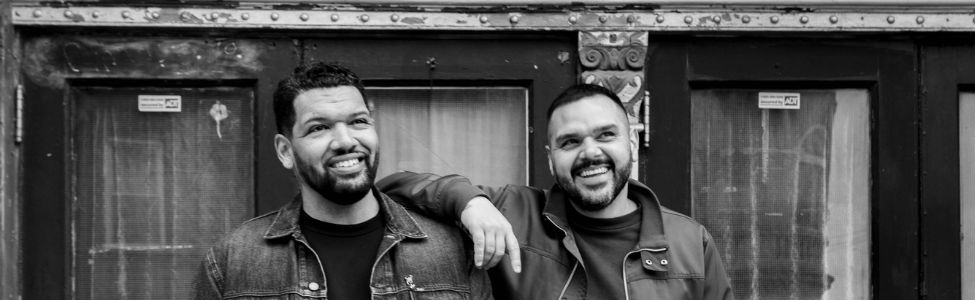
The first thing you notice about The Old G is its presence. The matte-black bottle stands with quiet certainty—the kind that feels intentional rather than performative. It looks modern, culturally fluent, and rooted in a point of view that does not waver once it is in your hand. That clarity comes from two men who did not grow up together but speak with the ease of people who could have.When Peter Ibrahim and Hebru Brantley talk, the partnership becomes obvious before the business story even starts. Their humor shows up first. Brantley likes to say their first encounter involved him punching Ibrahim in the chest like a scene from an old comedy. Ibrahim shakes his head and claims Brantley fell in love with him immediately. Brantley calls him a compulsive liar. Ibrahim accepts the accusation without hesitation.
Nothing about it feels scripted. Their rhythm is natural—full of laughter, interruptions, and small jabs that only work when the friendship is real. Their closeness forms the quiet architecture beneath the brand. Before there was a product, there was a connection. Before there was a bottle, there was chemistry. And before there was a name, there was a shared sense of what the world was missing.
Their strengths meet in a way that feels organic. Ibrahim spent years developing a gin that reflects his palate, his international background, and his belief that gin should be smooth, balanced, and welcoming. Brantley shaped the visual identity with the same intention he brings to his artwork, creating a design that carries cultural weight and modern elegance. Together, they shaped a brand that feels alive and deliberate, informed by two perspectives working in harmony instead of competition.
The rooms where no one looked like him
Long before The Old G existed, Ibrahim had been paying attention. For more than 15 years, he worked inside major spirits companies, sitting in strategy meetings, pitch sessions, and boardrooms from London to New York to Chicago. The pattern was impossible to ignore.
“There was a representation problem,” he says. “Everywhere I went, everyone I worked with, everyone I saw, all looked the same. There was no diversity or representation, especially as you get higher in the ranks.”
He explains it calmly, but the weight is unmistakable. He wanted to see people whose experiences and histories echoed his own. He rarely did.
“I wanted to see at least a few people I could relate to. But there were very, very few people who looked or sounded like me.”
He also understood who was actually shaping nightlife, taste, and spending power. He saw the gap between who created culture and who held ownership in the industry.
“We were always drinking everyone else’s stuff,” he says. “Never anything that represented us.”
At the same time, the absence he felt echoed across the industry. Marketing manager Jonn Richardson, who spent seven years managing the Bacardi portfolio, had seen the same thing.
“I spent seven years managing the Bacardi portfolio, including their gins, and most of that time I was one of the only Black men in the room,” Richardson says. “Not just in Chicago but even in our national meetings. Ownership is even rarer. That is why what we’re building with The Old G matters.”
Together, these experiences underscore why the brand exists at all.
The artist who understands the power of objects
While Ibrahim was navigating corporate patterns that felt increasingly narrow, Brantley was expanding the world through art. His work had become a cultural force, reimagining contemporary Black imagery with emotion and cinematic imagination. His characters carry symbolism. His colors carry memory. His style is instantly recognizable.
When Ibrahim suggested building a gin brand together, Brantley did not see it as a detour. He saw it as another medium.
“The bottle had to be a statement piece,” he says. “People display the things that matter to them. We wanted something that could live in someone’s collection. Something that draws curiosity.”
Traditional gin aesthetics rely on bright blues, greens, and heritage cues. Brantley and Ibrahim wanted something different. They studied silhouettes, materials, proportions, and tone. They chose a matte-black finish because it felt intentional, modern, and honest to who they were.
“People see it anywhere, and they gravitate toward it,” Brantley says. “That curiosity was something Peter and I always intended.”
A spirit designed to change minds
If Brantley shaped the design, Ibrahim shaped the flavor.
Ask him how many gins he has tasted, and he answers like a man who has lived through that number.
“It is definitely in the thousands,” he says. “At some point they come out your nose.”
His journey to The Old G took three years. He visited distilleries across continents. He studied production methods, tested ingredients, compared processes, and kept meticulous notes. He knew exactly what he wanted.
“I knew what the spirit had to be,” he says. “Flavorful, but not harsh. Something you can drink neat or with one mixer or in a cocktail. A positive experience.”
He also knew gin’s reputation in the United States. Many people tried gin once and never returned. They remembered the burn and the sharp edges. Ibrahim wanted The Old G to be the opposite. He designed it to be smooth.
The process was demanding. He developed batch after batch, adjusting botanicals, refining temperatures, and modifying distillations. He distilled nine times for clarity and texture. He added an oxygenation process to refine the finish. He discarded expensive batches that did not meet the standard.
“We probably did between 30 and 40 final liquids to get to this one,” he says. “It was long, laborious, and expensive.”
The result proved him right. The Old G earned Best Gin in Show at the 2025 Global Spirit Awards, scoring 98 out of 100. The Global Spirit Awards are known for rigorous blind judging, which means the gin’s quality had to speak for itself without branding or storytelling influencing the decision.
“No one can take that away,” Ibrahim says. “Once you earn it, it is yours.”
Richardson has seen that reaction everywhere.
“I’ve been in meetings with multimillionaires in the largest hospitality groups and in neighborhood liquor stores on the South Side,” he says. “They all say the same thing: that’s some of the best gin they’ve ever had. Gin isn’t the easiest spirit to sell, so that kind of reaction means everything.”
A perspective shaped by international background and an artist’s eye
Gin’s flavor comes from botanicals sourced across continents. That global foundation fits The Old G naturally. Ibrahim brings an international background and a global palate shaped by years of travel and spirits expertise. Brantley brings an artist’s eye and a sensitivity to visual storytelling. Together, they created a spirit that feels worldly, culturally aware, and grounded in modern taste.
The people we go outside with
From the beginning, Brantley and Ibrahim knew exactly who The Old G was speaking to. Their core audience is adults 35 to 55, or in their words, “the people we go outside with.” It is not a marketing strategy. It is lived experience.
This is the generation that learned life lessons from Shawn Carter lyrics and understands the weight of a line that feels like advice an older relative might have given you. They know the bravado of a moment, the quiet confidence of stepping into a room already carrying your story, and the bluesy undertone that comes from having lived enough life to tell it well.
They grew from analog childhoods into digital adulthood without losing their instinct for real connection. They value authenticity, intention, and the feel of something made with care. The Old G speaks to them naturally because its founders come from the same world, share the same shorthand, and understand how this generation shows up for taste, identity, and craft.
Premium craft with real accessibility
Everything about The Old G is premium. The botanicals are organic. The distillation is repeated nine times. The oxygenation process refines the finish. The design is custom and distinctive. Even so, the founders made a choice about price that reflects the heart of the brand.
“It is thirty-five dollars because we want it to be accessible,” Ibrahim says. “The quality is easily worth far more, but the intention is to meet people where they are.”
Brantley agrees. “We want the people who look like us to access the brand. We do not want to price them out.”
Their approach builds community rather than exclusivity. It creates presence without pretense. It reflects leadership instead of gatekeeping.
Redefining modern gin
The Old G is more than a bottle on a shelf. It is a shift in how the category can look, who it can speak to, and what it can represent. The design reflects culture. The flavor reflects discipline. The mission reflects lived experience.
“The product we are selling is real,” Ibrahim says. “People will understand that the moment they taste it.”
Brantley’s design ensures you feel that before you even open the bottle. For Richardson, the meaning is deeply personal.
“The name speaks to the community. Everyone knows an OG who guided them in some way,” he says. “I meet people in their 20s who are shocked that a regular Black man can own a liquor brand. Not a celebrity. Not an athlete. Just someone committed to quality. Our early awards are just the start of something special.”
This is art meeting craft. This is culture meeting expertise. This is The Old G. And this is only the beginning.