
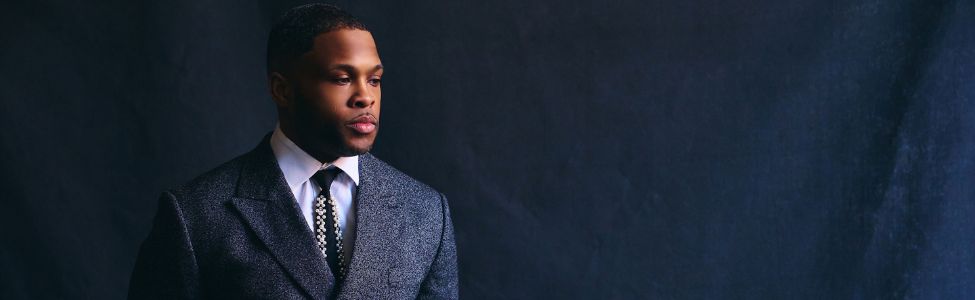
Dion Dawson walked into the studio dressed in all black, gold in his mouth and Chicago all over him, carrying the kind of ease that does not ask permission to be taken seriously. The conversation started with jokes about the heat because it was June, and Chicago had already chosen to act like summer had something to prove. Dawson laughed easily, answered directly and moved through the room with the kind of presence that made clear he was not there to perform the old custom of nonprofit respectability.
Dawson's work does not come from a polished distance. He is young, Black, funny, direct, sometimes blunt and deeply aware of what it means to be watched and underestimated. The gold grill, the all-black fit, the cadence, the humor and the sharp analysis all belong to the same person. One minute, he may laugh about Chicago weather. The next, he may explain why the traditional model of food philanthropy has left too many people standing outside, waiting for care that did not always feel like care once it reached them.
There is a brightness to Dawson that does not come from innocence or ease. It comes from the way he moves through hard stories without letting them darken his spirit or his whole face.
When asked who he is, Dawson did not begin with a title, a resume or a polished founder's statement.
"Oh, man, I am a lucky guy who fed some people, and then got a chance to feed more people," Dawson said.
That is one way to describe him. It is not his story. There are different ways to tell his whole story.
Dawson is the founder of Dion's Chicago Dream, a fresh food delivery organization that began on July 3, 2020, when he and his team fed 96 families. In the years since, that first act of service has grown into about 8 million pounds of fresh food purchased, packed and delivered, more than 60 wage-paying jobs created and more than 730,000 home deliveries completed. The numbers are significant, but they are not the only reason the story carries weight. For Chicago, the more urgent question is what had to happen before the dream for the model to mean what it means today.
Before Dion's Chicago Dream, food assistance in many communities often meant arranging life around scarcity, something many people have never had to consider. Families arrived early, stood outside, waited in lines, accepted what was available and sometimes walked away with food that did not reflect their taste, culture, health needs or dignity. Hunger was treated as a logistical issue, while shame, choice, quality and pride were left outside the conversation.
In Chicago, hunger has never been only about the absence of food. It has always been tangled in distance, income, transportation, health and the quiet indignity of having to rearrange a life around a necessity that should be a basic daily ritual. In CNW's "When Separate Equals Hungry," food insecurity was framed as a condition validated by zip code and often skin color, with access shaped by segregation, poverty, transportation and the quality of food available in Black and Brown neighborhoods. Nationally, 13.7% of U.S. households were food insecure at some point in 2024, 18.3% among households with children. In Cook County, the Greater Chicago Food Depository says 1 in 4 children are at risk of hunger, and during fiscal year 2025, its network served 2.3 million households and provided 96 million meals.
Those numbers move Dawson's work beyond the frame of a feel-good story and into the center of a public emergency. In a city with food banks, churches, pantries and volunteers who have been feeding families for generations, what does it mean to build a model that treats the recipient's experience as the design priority?
Dawson knows that experience from the inside. As a child, the line was not a metaphor. It was a place. The memory is physical: the weather, the waiting, the need, the gate separating families from the food they came to receive. At the time, there was no language for food systems or end-user experience. There was only the understanding that receiving assistance could still make a person feel small.
"I didn't understand that I was collecting data," Dawson said.
That sentence explains more about Dion's Chicago Dream than any slogan could. A child may not understand the economics of hunger, but a child knows when the process feels careless. A child knows the difference between receiving help and being handled.
That is why Dawson does not talk about food like charity. The language is closer to infrastructure, memory, accountability and power, driving home food's significance as an essential requirement to live.
"It was ultimately about controlling our supply chain," Dawson said. "The more you lean on volunteerism, the more you lean on donated food, you don't have control of your operations."
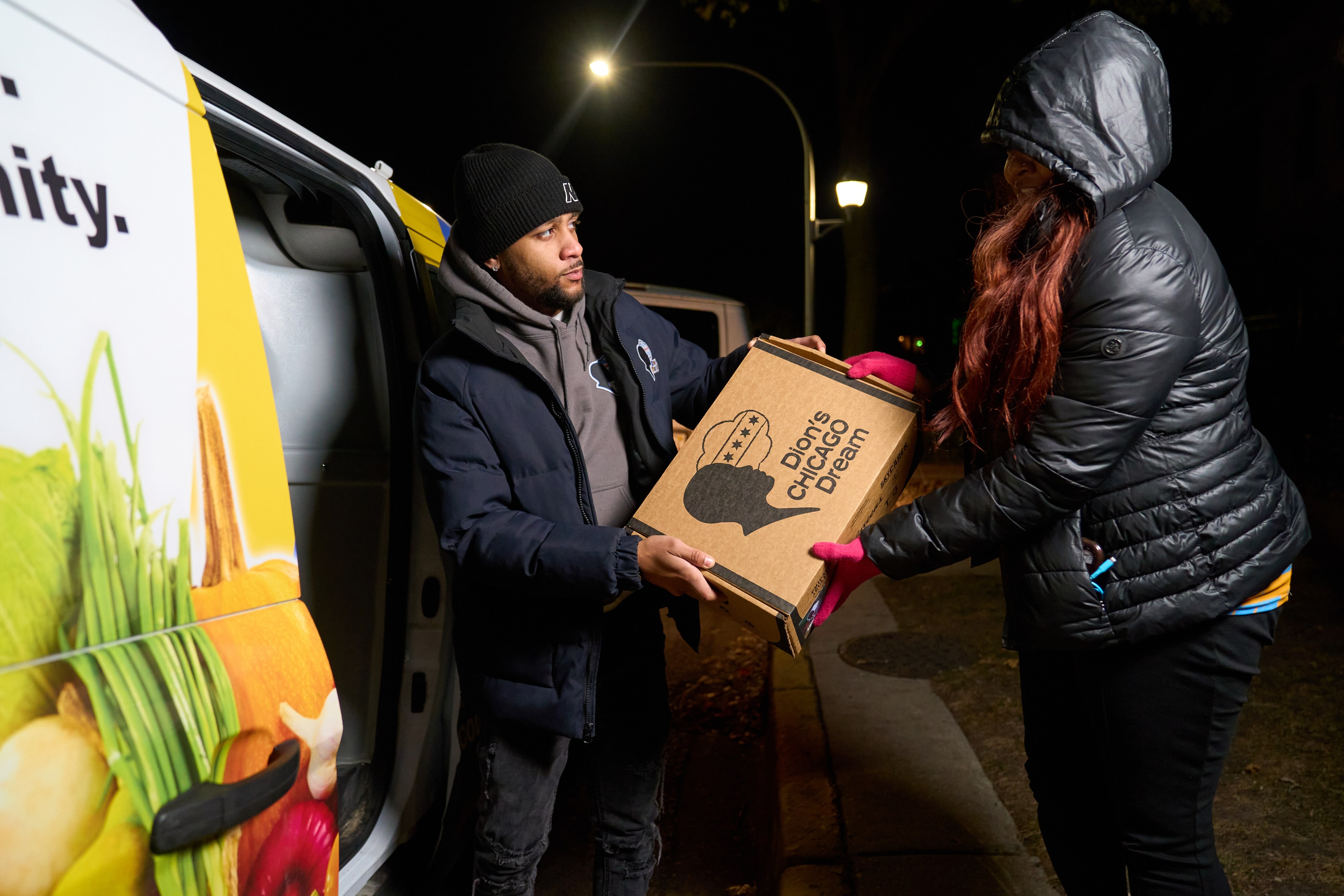
For Dawson, control is not about ego. It is about care. Purchasing food gives Dion's Chicago Dream more control over quality. Paying workers creates jobs instead of building a model entirely on unpaid labor. Delivering directly to homes changes the experience for families who might otherwise have to stand outside in the rain, heat or cold waiting for whatever is left.
"We should not all be feeding people outside on the folding table and having them wage war against the elements," Dawson said.
His point is not an indictment of everyone who has volunteered or donated. It is a challenge to the systems that have allowed need to lower the standard. Generosity has value, but generosity without design can still leave people feeling unseen. The 2025 Greater Chicagoland Hunger Report found that 1 in 4 people in the region were facing food insecurity, while about 1.4 million households could not afford the basic cost of living in their county. Numbers that large demand better systems, better metrics and a more honest conversation about what happens after food is handed out.
Dawson grew up in Chicago, and his relationship with the city is not decorative. Chicago, for him, means beauty and segregation, winters and food, contradictions and a kind of truth that does not let people look away from the country's larger failures.
"You can't hide from the real U.S. experience in Chicago," Dawson said.
Englewood, specifically, is part of his grounding. It is the place his mind returned to when he was deployed in the Navy, standing outside a ship surrounded by darkness so complete that it triggered a panic attack.
"I was outside the ship, it was pitch black, and I had a panic attack," Dawson said. "The thing that calmed me down was thinking of home, thinking of Englewood."
Englewood was not only where life had been hard. It was where his body found calm, and where his identity returned when the world felt too large and too dark. That pride now shows up in the work, not as nostalgia, but as responsibility.
"Having that pride has since translated well into my work and how it made me commit to holding myself accountable," Dawson said.
Dawson left elementary school as valedictorian, before life shifted and he found himself navigating homelessness in Englewood while commuting nearly an hour across the city to attend Curie High School, a school with a freshman class of about 1,000 students. He had no uniform, a detail that, for a teenager, draws attention.
"High school was rough because I was just trying to survive," Dawson said. "It wasn't that I didn't want to go. You never feel comfortable or settled."
Dawson's experience was personal, but it was not isolated. Chicago's 2025 Point-in-Time Count estimated 7,452 people experiencing homelessness on a single night, and Black Chicagoans represented 53.2% of that population. The Chicago Coalition to End Homelessness reported that 22,438 CPS students experienced homelessness during the 2024-25 school year, instability that often hides inside classrooms, invisible to the adults around it.
Still, hardship did not erase joy. Friends from elementary school, Mark, Antoine and Paris, let him stay over, borrow clothes and remain a child in a season that could have made him feel like a problem to be managed.
"I couldn't do any of this without you all," Dawson said.
That gratitude shows what Dawson understands about helping another person. Help is not neutral. The delivery, tone, quality and memory it leaves behind all shape how care is received. Dion's Chicago Dream is built around that truth.
In Dawson's model, food is selected, purchased, packed and delivered with a standard. The emphasis on fresh produce is part of a refusal to treat families as if anything should be good enough because they are in need.
"Nobody likes donated food, so stop giving it like it's brand new," Dawson said.
The line can make a room laugh, but the humor carries an old wound. The critique is not that people should stop giving. Rather, communities should stop being asked to confuse leftovers with love. Dawson believes philanthropy must be pushed harder. Money can move, programs can launch, food can be distributed, and still the language around need can make inequality sound accidental.
"We're not underserved," Dawson said. "It's people bullshi##ing. It's not a money issue. It's an allocation issue."
That is where the critique moves beyond personal experience and into sector analysis. What is the metric of success? Pounds of food moved, or food eaten, enjoyed and used? The number of families reached, or the dignity preserved inside it?
"We always talk about the food pantry," Dawson said. "We never ask ourselves what metric determines whether that pantry was successful."
The work does not reject philanthropy. It demands that philanthropy grow up, mature, move beyond the comfort of generosity and into the discipline of accountability, and treat the person receiving the service as the end user, not a symbol of need.
There is also a business case embedded in the critique. Dawson has had to prove that a model built around fresh food, paid workers and dignity can scale without being wholly supported by the richest and most powerful people in Chicago.
"A lot of people who do show up philanthropically, they've been on autopilot for a couple decades," Dawson said. "Having to break into that market and get them to see that we're worth investing in, and that our model is scalable."
The skepticism around fresh food came early.
"I can’t tell you how many people in the beginning tried to tell me, 'Oh, you can't give them new food,'" Dawson said. "I said, 'You’ve lost your mind.'"
Fresh food is not excess. It is not optional. Fresh food is the point.
Dawson remembers conversations with his mother, when people would say, "Tell your son to come back and get this food," and he had to make clear that Dion's Chicago Dream would not take everything simply because it was offered.
"We've never had a line we wouldn't cross," Dawson said. "People think that the line is just caring about people. No. That's the minimum. After you're in the door, how do you care about people? How do you hold yourself accountable? And how, when you get it wrong, how do you better yourselves?"
Dion's Chicago Dream delivers food directly to homes, purchases fresh produce and pays workers. The wage floor is $20 an hour, a number Dawson admits is still not enough in this economy, but one the organization refuses to go below.
"We don't pay a penny under that," Dawson said.
Dawson has worked overnight at Amazon. He has done delivery jobs. The exhaustion of leaving one job tired and entering another space where labor is undervalued again is not theoretical to him.
"I'm human," Dawson said. "When you know better, you do better. I don't ever want to be that person that when someone is telling their life story, you were part of the people or the parties that did them wrong."
That was one of the most revealing things he said. It turns the work from a service model into a moral one, a question of whether Dion's Chicago Dream will appear in someone's life story as something that preserved dignity, or something that repeated the harm Dawson once knew.
Even the branding comes back to pride. Dawson is protective of Dion's Chicago Dream merchandise and clear about who wears it. The Dream Team should look good, the trucks should look good, the work should feel good before the box is even opened.
"When you see our merch and our team, we fly," Dawson said. "You gotta want to look good and feel good."
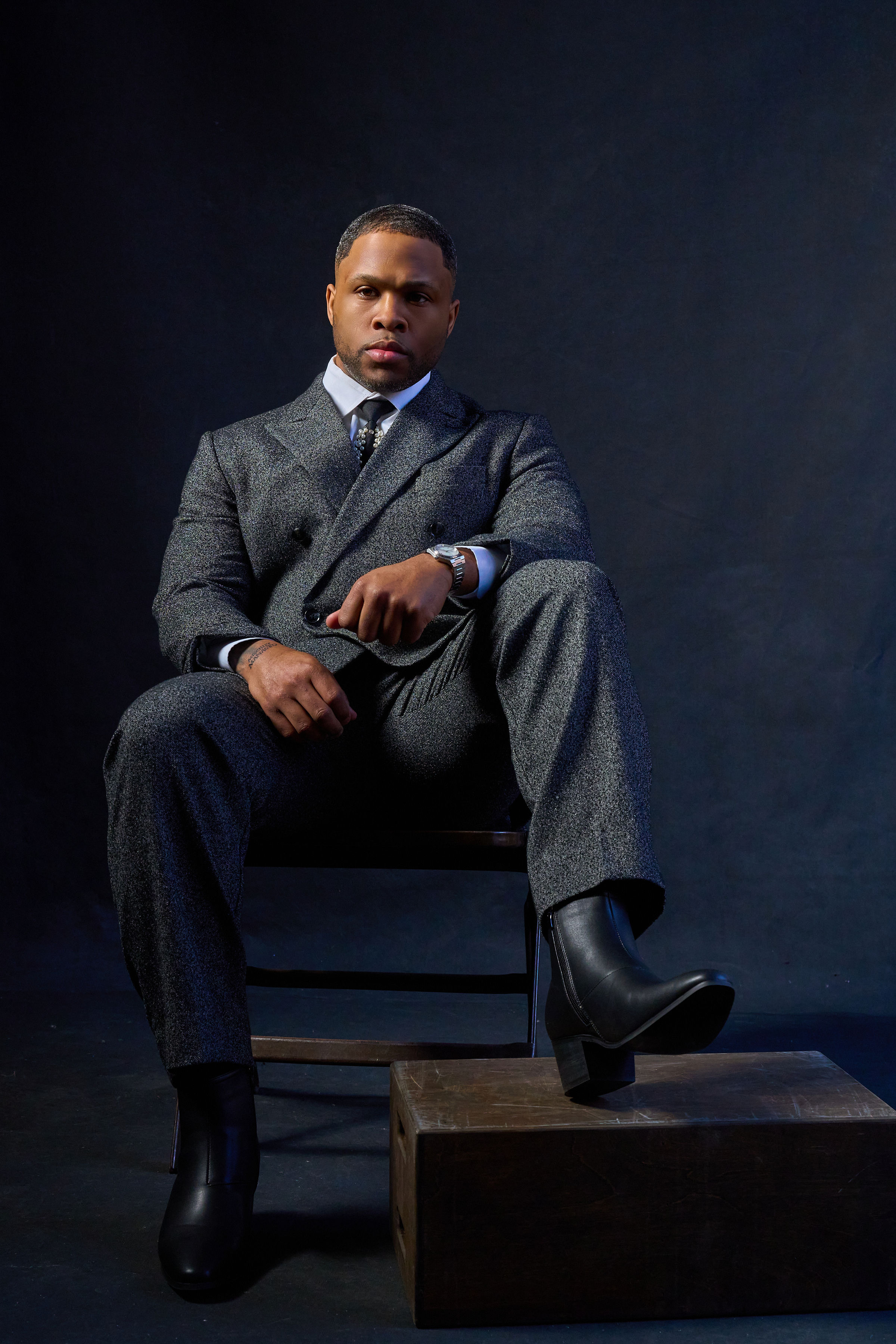
For Dawson, that is dignity. People notice when care has been taken. In communities too often asked to accept what is left, presentation becomes part of the message. That is why Dawson's own presence belongs in this story, the all-black look, the gold grill, the humor, the Chicago cadence, the refusal to become palatable. His existence is proof that a young Black man from Englewood can be stylish, blunt, funny and fully himself while building something disciplined, measurable and worthy of serious investment.
When asked what he would say if he had the world's attention, Dawson did not begin with a pitch. Love came first.
"I love you," Dawson said. "You're more than enough. I can be everything, but I'm Black first."
Then, because he is Dion Dawson, the tenderness came with a challenge: "Nobody likes donated food, so stop giving it like it's brand new."
That is the range of him. Love and critique. Humor and memory. A man who can honor the people who helped him survive while holding systems accountable for making survival harder than it had to be.
When the conversation turned toward what Dawson is proud of now, the answer moved toward his people.
"I literally credit my team," Dawson said. "I love hiring talented people."
Dion's Chicago Dream is no longer only about one man's memory or one act of service. The organization has become an operation that requires talent, discipline, logistics and trust, and Dawson's team is part of the proof that the mission can scale without abandoning its soul.
The next chapter brings the dream back to Englewood in a more permanent way. Dawson said Dion's Chicago Dream is preparing to open Dreamville Campus, a 20,000-square-foot facility and coworking space in the neighborhood that raised him, built to support the volume the organization has reached while creating room for other builders and mission-driven leaders to work near the infrastructure of a model rooted in dignity.
"We have to do it," Dawson said. "With the volume we're using right now, we have to expand."
The same neighborhood that steadied Dawson when he was deployed to the Navy will now hold the infrastructure for a food access model reaching families across Chicago and beyond. More space means more capacity, more cold storage, more jobs and a stronger base for the system Dawson has been building since those first 96 families.
The expansion changes how the story should be understood. Dion's Chicago Dream is no longer only the image of a community fridge or a delivery route. According to Dawson's 2026 media materials, the organization has scaled from startup to a roughly $7 million operation, raised more than $15 million and is serving more than 5,300 households weekly while delivering more than 250,000 pounds of fresh food monthly across 182 zip codes.
Through Dream Deliveries, Dream Fridges and Dream Vaults, the model has grown into a full suite of food access solutions built around health equity, logistics and dignity.
That next chapter also includes Cosmic Crate, Dawson's logistics technology platform created to help mission-driven teams scale impact. The dream began with food, but the problem Dawson is trying to solve has always been bigger than food. It is about building systems with enough care, consistency and intelligence to meet people where they are.
Dawson may describe himself as a lucky guy who fed some people, but what he has built is far more deliberate than luck. Dion's Chicago Dream grew from the memory of standing in line, knowing what it felt like to need help and still feel diminished by the way that help was delivered. That experience did not simply inspire the organization. It shaped the standard behind it.
Now, as Dion's Chicago Dream grows beyond its first 96 families and expands its footprint in Englewood, Dawson is no longer the child waiting on the other side of the gate. He is in a position to redesign what happens there.
The line he remembers became the standard he refuses to lower.