
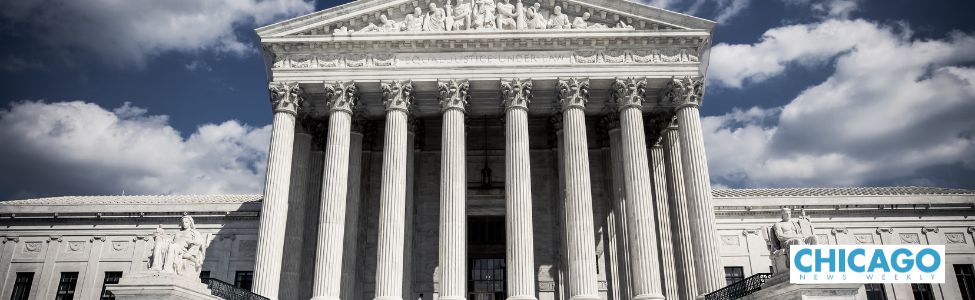
The Supreme Court closed out its 2025-26 term on Tuesday, capping a stretch of rulings that touched citizenship, voting, presidential power, money in politics, gun rights and transgender athletes. Several decisions landed with narrow majorities and sharply worded dissents, a sign of how divided the justices remain on questions that reach into ordinary American life. Here's a plain-language rundown of the biggest cases, what the court actually decided, and what it means going forward.
Birthright citizenship survives a presidential challenge
The term's marquee case, Trump v. Barbara, tested whether the president could unilaterally narrow who counts as a U.S. citizen at birth. President Trump's first-day executive order had sought to deny automatic citizenship to children born on U.S. soil to parents who are undocumented or only temporarily present in the country.
The court said no. Chief Justice John Roberts wrote for the majority that the framers of the Fourteenth Amendment extended citizenship's promise to every free-born person in the country, and that the court was keeping that promise. Roberts assembled a coalition that included Justice Amy Coney Barrett among the conservatives, joined by the court's three liberal justices, for a 6-3 ruling.
It wasn't unanimous among the dissenters in tone or reasoning. Justice Clarence Thomas, in a 91-page dissent joined by Justice Neil Gorsuch, argued the majority's decision devalues citizenship as understood by the amendment's framers and accused his colleagues of reshaping the Fourteenth Amendment to fit their own preferences. Justice Samuel Alito filed his own dissent as well.
What it means: for now, the rule that has governed American citizenship since the 1898 case United States v. Wong Kim Ark stays intact. Every child born on U.S. soil, regardless of a parent's immigration status, remains a citizen at birth, just as the children of Japanese immigrants detained in internment camps during World War II were automatically granted citizenship. Immigration advocates are calling it a major win, though some immigration restrictionists argue the ruling may now push the administration toward more aggressive deportation and visa policies aimed at people before children are born.
Protected status ends for roughly 350,000 Haitians and 6,000 Syrians
In Mullin v. Doe, consolidated with Trump v. Miot, the court cleared the way for the administration to terminate Temporary Protected Status for Haitian and Syrian nationals, a humanitarian program Congress created in 1990 for people who can't safely return to their home countries. Haiti's designation dated back to the 2010 earthquake and had been repeatedly renewed over 16 years; Syria's stemmed from its civil war.
Writing for a 6-3 majority, Justice Samuel Alito held that the TPS statute broadly bars courts from reviewing most challenges to how the Secretary of Homeland Security designates, extends or ends a country's status, and found Haitian plaintiffs' claim that the termination was racially motivated unlikely to succeed, though it sent that narrower question back to lower courts rather than resolving it outright. Justice Elena Kagan dissented, joined by Justices Sonia Sotomayor and Ketanji Brown Jackson.
What it means: roughly 350,000 Haitians and 6,000 Syrians who have lived and worked legally in the U.S. for years now face the loss of that status and their work permits once the terminations formally take effect, with no real avenue to challenge the decision in court. The ruling doesn't deport anyone automatically, and it stopped short of declaring Haiti or Syria safe to return to, but it strips away the main legal tool TPS holders had used to keep their status in place. Advocates warn the fallout will hit hardest in cities with large Haitian communities, including parts of Ohio, where some residents could lose access to things like driver's license renewals within days of the ruling.
Trump can fire independent agency officials a 90-year wall comes down
In a separate blow to a different kind of check on presidential power, the court ruled the president can remove the heads of independent agencies without the "cause" requirements Congress built into their job protections decades ago. The 6-3 decision found that Trump's 2025 firing of Federal Trade Commissioner Rebecca Kelly Slaughter, done without citing any wrongdoing, was lawful, further dismantling a precedent that had stood for roughly nine decades and once limited a president's control over agencies meant to operate as independent watchdogs.
The same week, the court left a separate fight over Federal Reserve Governor Lisa Cook's job unresolved in the administration's favor for now: in a 5-4 vote, the court allowed Cook to keep her position while her case continues, with Chief Justice Roberts writing the majority opinion joined by the court's three liberal justices and Justice Brett Kavanaugh.
What it means: agencies like the FTC, the SEC, and similar bodies that were designed to operate with some independence from the White House are now far more exposed to direct presidential control. The Fed, at least temporarily, has been treated as a special case but that question isn't fully settled.
Mail-in ballots can still arrive late in Mississippi and beyond
Ahead of this fall's midterms, the court upheld a Mississippi law letting election officials count mail ballots that are postmarked by Election Day but arrive up to five days later. The 5-4 ruling, authored by Justice Barrett and joined by Chief Justice Roberts along with the court's liberal justices, was a defeat for the Republican Party, which had challenged the law.
What it means: similar grace-period laws in other states are likely to survive legal challenges heading into the midterms, meaning ballots that are mailed on time but arrive a bit late will generally still count.
Voting Rights Act takes another hit in Alabama
Earlier in June, the court allowed Alabama to use a congressional map for its 2026 elections that a lower court had already found racially discriminatory. The unsigned order let Alabama proceed with a redrawn map even after a lower court flagged it, marking an early test of a separate ruling, Louisiana v. Callais, that had already made it considerably harder to prove Voting Rights Act violations in redistricting cases.
What it means: several Southern states are now redrawing congressional maps in ways that reduce the number of majority-Black districts, a shift expected to affect who represents those areas in Congress for years to come.
Campaign spending limits loosened
The court also struck down a long-standing, Watergate-era cap on how much money political parties can spend in direct coordination with their own candidates, a case brought by Republican groups including the National Republican Senatorial Committee. The ruling drew a forceful dissent from Justice Elena Kagan, who, according to reporting from the ruling, used a hypothetical candidate to illustrate how the decision could let wealthy donors funnel large sums through party committees directly into a campaign's coffers.
What it means: political parties can now spend far more in lockstep with their preferred candidates, a change both parties are already moving to capitalize on ahead of this year's midterms, even as Democratic campaign committees have publicly condemned the decision.
Transgender athletes barred from girls' and women's school sports
In a case combining challenges from West Virginia and Idaho, the court upheld state laws barring transgender athletes from competing on girls' and women's school sports teams, rejecting arguments that the bans violate Title IX's protections against sex discrimination.
What it means: similar bans in other conservative-led states are now on far firmer legal footing, and the ruling is likely to encourage more states to adopt comparable restrictions.
Gun rights extend onto private property
In Wolford v. Lopez, the court struck down a Hawaii law requiring concealed-carry permit holders to get explicit permission before bringing firearms onto privately owned property that is open to the public, such as a gas station or restaurant. The 6-3 ruling continues a recent pattern of the court expanding Second Amendment protections beyond the home.
What it means: gun owners with concealed-carry permits in Hawaii and potentially in states with similar default-restriction laws will no longer need a business's explicit go-ahead to carry on site, shifting the legal default toward allowing firearms unless a property owner posts a sign saying otherwise.
The bigger picture
Taken together, this term's rulings expanded presidential authority over agencies once insulated from the White House, narrowed some voting-rights protections while preserving mail-ballot flexibility, loosened campaign finance limits, and delivered a major defeat to the administration's most aggressive immigration move while handing it wins on deportation authority and transgender athletics. The common thread running through nearly every case: narrow majorities, unusual coalitions that didn't always break along the expected conservative-liberal lines, and dissents warning that the rulings could prove difficult to walk back in the years ahead.
This is a sensitive and fast-moving news topic; coverage and legal analysis will continue to develop in the days ahead as the full opinions are parsed by legal experts.