
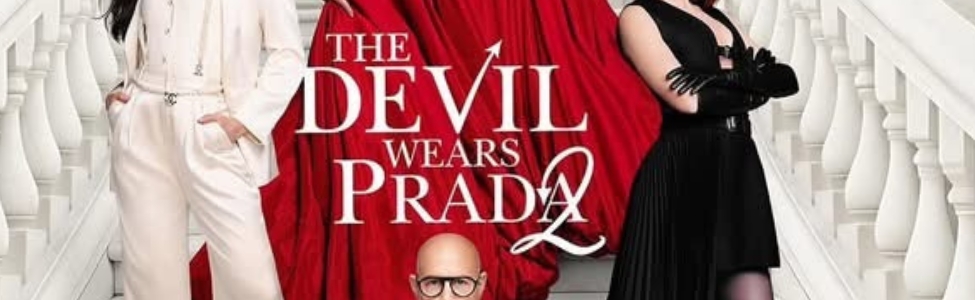
Like millions of others who have been patiently waiting for twenty years, I was thrilled when the sequel finally made its debut on April 17. Off I went to see Miranda Priestly and Andy Sachs light up the big screen once again. Sitting in the theater felt less like watching a movie and more like a gathering of old friends; I couldn’t wait to catch up. Directed by David Frankel and written by Aline Brosh McKenna, The Devil Wears Prada 2 is a comedy-drama that features Meryl Streep, Anne Hathaway, Emily Blunt, and Stanley Tucci reprising their iconic roles, joined by an impressive supporting cast including Justin Theroux, Lucy Liu, and Kenneth Branagh.
Two decades after leaving her position as a co-assistant at Runway magazine, Andrea ”Andy” Sachs has become a respected, hard-hitting reporter in New York City. The film hits the ground running at a journalism awards event. Andy is at the podium when she drops a bombshell: her entire newsroom has just been abruptly laid off via text message.
Meanwhile, Miranda Priestly, Editor-in-Chief of Runway and Andy’s former mentor, is under fire for failing to vet a fluff article about a brand that uses sweatshop labor. Instantly, the audience is left wondering: How did something like this slip past Miranda? And so, the story begins, questioning whether she is still the stern master of control on top of everything in her universe.
This review is meant to pique your interest, so you’ll check it out and draw your own conclusions—I personally hate reviewers who spoil the entire plot. I will say, however, that this sequel is solid, charming, and effectively addresses the rapid, ever-evolving changes in both modern society and the journalism industry.
There were moments when I was moved to tears by how accurately the film reflects real-world media crises, such as mass layoffs, budget cuts, and the disruptive impact of AI. I love that the writers took the effort to capture the obstacles journalists face today, including direct attacks from billionaire moguls and political administrations who seek to control free speech to fit their own ideologies. The film brilliantly exposes the harsh realities battering a media landscape that once seemed invincible.
That is the true heart of the movie. Runway is under attack, forcing us to revisit a familiar theme: Is Miranda aging out, or is she getting better as she adjusts to a changing world? The enemy lies dormant until the perfect moment to strike, arriving in the form of a wealthy billionaire looking to buy out the magazine, while the heir to Runway wants nothing to do with the legacy—only the profit from its sale.
How do the honorable maintain their integrity when the vipers are closing in? Yet, amidst all the tension swarming around the best-dressed people in New York and Milan, the characters maintain their dignity. The notion that being well-dressed is synonymous with intention and impact goes a long way in this beautifully shot film. The scenes captured on location are breathtaking, reminding us that beauty itself is a form of power.
Twenty years later, Miranda Priestly remains true to form. She is older, looks flawless, and though some might call her softer, she hasn’t lost her steel backbone; she is simply more tempered in how she wields her might. We see an uncharacteristically tired side of Miranda as she struggles to navigate modern digital media. While some of her tyrannical office behaviors remain, modern HR complaints have dulled her sharpest edges, making her appear slightly less haughty.
Enemies attack Miranda while she is down, using her own medium against her. Her right-hand man, Nigel, explains the bleak reality: nobody reads Runway’s print edition anymore, and the brand has been forced to embrace online clickbait and cheaply made, short-form content to appease advertisers. One key advertiser is Dior, which now employs Andy’s former co-worker, Emily. Emily has become a ”figurehead” in the high-fashion world, yet she remains the same hungry status-seeking character with whom we emphaize. Meanwhile, Andy has mellowed into a grounded professional.
Showing her enduring faith in Andy’s abilities—and knowing exactly what makes Emily tick—Miranda assigns Andy to redirect the controversy surrounding the Runway puff piece. After writing serious articles that gained minimal traction online, Andy rescues her standing by brokering a coveted interview with a major player in the world of big finance.
The surprises keep coming from there. Curious? Interested? You’ll have to buy a ticket to find out how the cards fall. It is a gripping, touch-and-go drama. You will gladly ride the wave as the unique, tense, and complex relationship between Miranda and Andy proves that opportunity can choose to ring twice.
During Milan Fashion Week, Nigel throws what may be his last big Runway gala, guest-starring Lady Gaga. Andy devises a brilliant plan to save the magazine, using her sharp negotiation skills to resolve their dilemma. Meanwhile, Miranda—possessing x-ray vision that pierces through the politics—recognizes who the real enemy is long before Andy does.
Once the horses are out of the gate, Miranda gets in the saddle and executes her master plan. Along the way, she realizes she has taken Nigel for granted over the years. To make amends, she invites him to deliver the gala’s keynote speech in her place, allowing her and Andy to finalize a deal with a new partner. The film concludes with Nigel revealing a massive secret to Andy, while Miranda grants her a meaningful surprise of her own.
The Devil Wears Prada 2 has already grossed $155 million in the United States and Canada, and $290 million in other territories, for a spectacular worldwide total of $445 million. Debuting at $76.7 million during its opening weekend, it easily topped the box office, successfully outgrossing the original film’s legendary numbers.

Visionary Kai EL´ Zabar has worked as CEO of arts organizations and as editor, writer and multimedia consultant accumulating a significant number of years in experience as an executive, journalist,publisher, public relations, media training, marketing, internal and external communications. Kai currently continues her life’s work as Editor-in-Chief Of Chicago News Weekly where she has resumed her column, “E NOTES.” She is ecstatic to be in the position to grace Chicago and the world with a publication that articulates the Black voice.