

A decade ago, Stratton was raising four daughters while caring for her mother, Velma, a public school teacher and adult literacy instructor who had been diagnosed with Alzheimer’s disease. The days were relentless — school schedules layered onto medical appointments, the quiet emotional labor of watching someone you love slip away while still needing everything from you. One evening, as the television played in the background, a news segment aired about Illinois lawmakers moving to strip health care benefits from seniors.
“I yelled at the television,” Stratton recalled. “I honestly said, somebody should run against my state representative.”
At the time, she did not imagine that person would be her. But the anger lingered. So did the clarity.
“I knew how hard it was to care for my mother,” she said. “And I knew there were so many people like her who didn’t have the resources we had.”
That moment did not simply spark a campaign. It clarified a responsibility.
Today, Stratton is the first Black lieutenant governor in Illinois history and a Democratic candidate for the U.S. Senate. She is running in a March 17 Democratic primary against two sitting members of Congress — U.S. Reps. Raja Krishnamoorthi (D-8th) and Robin Kelly (D-2nd) — in a race to replace retiring U.S. Sen. Dick Durbin (D-Ill.).
The contest is sharply defined by disparities in resources and early polling. According to the most recent Federal Election Commission reports available, filed through Sept. 30, 2025, Krishnamoorthi reported $24.9 million in total receipts, $6.8 million in disbursements, and $18.1 million cash on hand. Kelly reported $2.7 million in receipts, $754,261 in spending, and nearly $2 million remaining. Stratton reported $2.1 million raised, $1.17 million spent, and just under $920,000 cash on hand.
All publicly available polls conducted to date show Krishnamoorthi with a double-digit lead.
In a primary shaped by fundraising totals, momentum narratives, and compressed attention spans, Stratton is not asking voters to be impressed. She is asking them to look closely.
Stratton grew up on the South Side of Chicago, raised by parents who treated service as a daily obligation rather than a career aspiration. Her mother taught in public schools and community colleges. Her father was a community physician and a Navy veteran. Together, they modeled an ethic that would later define Stratton’s understanding of leadership.
“Service is the rent you pay for living on this earth,” she said.
She still lives on the South Side. She still frames leadership as something practiced in relationship with others, not imposed from above.
“There is no Juliana Stratton agenda,” she said. “It’s the people’s agenda. Government should be a partner to the people, not a roadblock.”
Before entering electoral politics, Stratton worked as a restorative justice practitioner and ran a mediation and alternative dispute resolution firm. She taught negotiation skills across the country, learning early that outcomes depend less on authority than on trust — and that power without accountability rarely produces justice.
“You cannot come to a negotiating table with someone who is operating in bad faith,” she said. “They’re not trying to do the right thing.”
That skepticism of power without accountability would follow her into public life.
Stratton’s entry into electoral politics was neither accidental nor symbolic. In 2016, she challenged Ken Dunkin in the Democratic primary for Illinois’ 5th House District at a moment of deep intra-party tension. Dunkin had drawn sharp criticism from fellow Democrats for withholding support from legislation that would have reversed cuts to social service programs under Republican Gov. Bruce Rauner.
The race became a referendum — not simply on one lawmaker, but on what Democratic accountability was supposed to look like when core social services were under threat.
Stratton secured the endorsement of then-President Barack Obama and drew strong backing from labor unions, particularly those representing child care and home care workers. Her campaign centered social services, labor protections, and the belief that Democratic leadership should not equivocate when vulnerable communities are at risk.
She won decisively, capturing 68% of the vote in one of the most expensive Illinois House races of the cycle, with roughly $6 million spent between the candidates. The victory established her not as a protest candidate, but as a disciplined political operator willing to take risks — and capable of winning.
Like many Illinois Democrats of her generation, Stratton benefited from established party infrastructure early in her career — but her rise did not follow the traditional leadership pipeline, and she did not assume party or legislative control roles.
Stratton entered the Illinois House with urgency and little patience for symbolic wins. By August 2017, she had led 25 bills, with nine advancing to Gov. Rauner’s desk, and served on multiple committees.
She sponsored legislation ending preschool expulsions, which disproportionately affected Black and Brown children and often set them on a path toward long-term academic and behavioral consequences. She helped dismantle school-based booking stations — rooms inside schools used to process student arrests — making Illinois one of the first states to outlaw the practice entirely.
She did not frame the work as radical. She framed it as overdue.
When she became lieutenant governor in 2019, Stratton was clear about what she would not accept: a role defined by ceremony rather than consequence.
“I told the governor I didn’t want to do this if the job was just, ‘I don’t feel like going — send Juliana,’” she said. “I wanted to bring my full, authentic self to the table and be a true partner in governance.”
According to public records, Stratton has since spearheaded the Justice, Equity, and Opportunity Initiative and chairs the Illinois Council on Women and Girls, the Governor’s Rural Affairs Council, the Military and Economic Development Council, and the Illinois River Coordinating Council.
The shift from legislator to executive forced a recalibration. Advocacy became implementation. Ideas became systems. Progress slowed — but impact widened.
What Stratton gained in the lieutenant governor’s office was not simply a larger platform, but a wider map — and a different relationship to authority.
Her portfolio required her to move far beyond the familiar geography of Chicago politics, into rural counties and small towns where state officials often appear only during moments of crisis or election cycles. As chair of the Governor’s Rural Affairs Council, she convened local leaders around hospital closures, food insecurity, and workforce shortages — problems that rarely register as national headlines but define daily life for thousands of Illinois residents.
“You can’t govern people you don’t show up for,” Stratton said. “And you can’t show up once and think that’s enough.”
Some meetings were tense. In communities wary of Democratic leadership, residents questioned whether state attention would last beyond the visit. Others arrived carrying years of frustration, skeptical that government could offer anything beyond sympathy. Stratton’s approach was consistent: listen first, resist defensiveness, and return with follow-through — even when answers were incomplete.
She was often the only Black woman in the room. Sometimes the only woman at all. She did not foreground that fact, but she did not ignore it either. Her strategy was not to win the room quickly, but to stay long enough to be trusted.
Colleagues describe her governing style as methodical rather than performative — someone who prepares extensively, asks detailed questions, and resists speaking before she understands the full context of an issue. When disagreements arise, she presses for clarity instead of consensus, believing unresolved tension is preferable to superficial agreement.
Health care remains the throughline of Stratton’s public work — not as abstraction, but as lived reality.
“When people don’t have access to health care, it’s not just about a doctor or a diagnosis,” she said. “It’s about being able to go to work. It’s about caring for your family. It’s about education and generational wealth.”
In the interview, Stratton returned repeatedly to health care, accountability, and lived experience — issues that have shaped both her record and her decision to run.
She spoke about rural hospitals on the brink of closure, families choosing between rent and treatment, and life expectancy gaps between ZIP codes that can stretch two decades within the same metropolitan area.
“We don’t have a health care system,” she said. “We have a sick-care system.”
Asked directly about solutions, she did not hedge.
“There’s the bill for Medicare for All,” Stratton said. “I would support that bill.”
At the same time, she is candid about the complexity of reform. Affordability, access, provider sustainability, and industry incentives are deeply misaligned.
“We can’t keep pretending this system works,” she said. “It doesn’t work for families, it doesn’t work for providers, and it doesn’t work for outcomes.”
Stratton speaks less about abstract growth than about what families can realistically sustain.
“People need access to health care,” she said, “and they need a livable wage — not minimum, a livable wage.”
Without it, she argues, families are locked into impossible choices — between food and medicine, rent and education. Economic policy, in her view, must be evaluated by lived consequence, not ideological neatness.
Stratton enters the Senate race without many of the structural advantages that define early front-runners. She has rejected corporate PAC money and is building her campaign largely through grassroots support.
“This is a harder campaign to build, yes,” she said. “But what it does not make more challenging is the ability to look voters in the eye and say, ‘I am here to fight for you.’”
She is running a deliberate race, prioritizing governing experience and policy depth over spectacle.
“People are tired of talking points,” she said. “They want to know not just what you want to do, but what you’ve done.”
When Stratton became Illinois’ first Black lieutenant governor, she did not experience the moment as personal triumph.
“You don’t do this to make history,” she said. “But you can’t dismiss the importance of making history.”
She often notes that the first time she ever walked into the Illinois State Capitol was after she had been elected.
“How can I be it if I can’t see it?”
That question led to Girls Lead, a program Stratton launched to expose young girls to women leaders across state government — showing them, early, that power is neither distant nor forbidden.
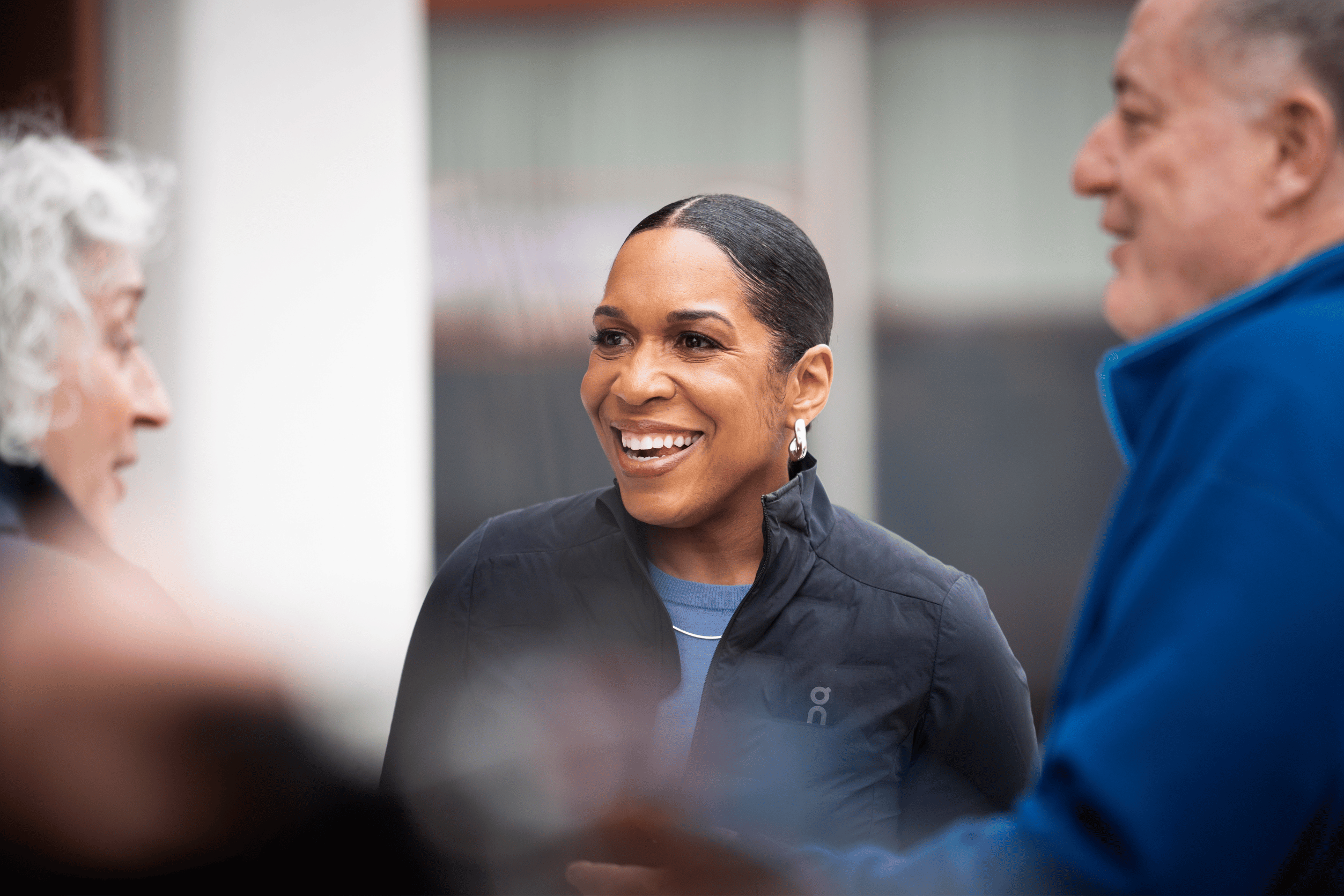
Public life has taught Stratton how to be visible. It has not insulated her from what visibility takes.
At home, she is intentional about stillness — about cooking, music, dancing in the kitchen, and quiet moments that restore rather than perform.
“I have to create space to breathe,” she said. “Otherwise the work can take everything.”
There are moments of doubt. Moments when expectation feels heavy.
“But I don’t let it paralyze me,” she said.
Stratton speaks openly about the urgency of the political moment, but she resists panic as strategy.
“I’m hopeful,” she said. “Not because things are easy — but because history shows us that change comes from people who refuse to give up.”
Asked how she wants to be remembered, she does not list titles.
“Public service is not a monologue,” she said. “It’s a dialogue.”
In a race often measured by speed and scale, Juliana Stratton is asking voters to consider a different standard — whether care, accountability, and lived experience are still recognized as qualifications for power.
It is not the fastest argument in the field. It is, unmistakably, a deliberate one.