
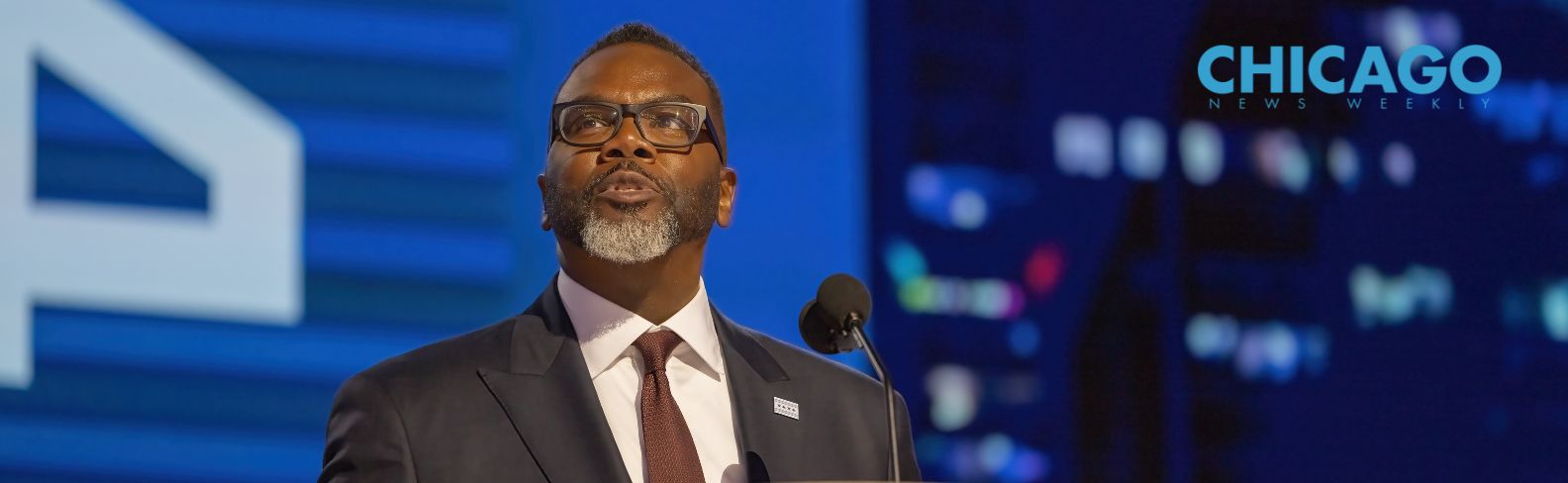
CHICAGO Mayor Brandon Johnson made his bid for a second term official Sunday, using a sweeping reelection speech to defend his first three years in office while promising a second term focused on reopening closed schools and mental health clinics, reducing violence, investing in working families and shifting more political power toward communities he says have long been left behind.
Speaking before hundreds of supporters at the DuSable Black History Museum and Education Center on Sept. 13, Johnson entered an already crowded 2027 mayoral race after months of questions about whether he would seek another term. His announcement drew labor leaders, elected officials, faith leaders and members of Chicagos progressive political coalition.
"My name is Brandon Johnson, and Im running for re-election, " Johnson said early in the speech.
But the mayor spent relatively little time simply announcing his candidacy. Instead, Johnson delivered an extended argument for what he believes his administration has accomplished, where it has fallen short and what another four years under his leadership could look like.
This is bigger than any one campaign, Johnson said. And certainly it's bigger than any one individual. This is a movement, and it belongs to all of us, the people.
Throughout the speech, Johnson returned to the working-class politics that helped propel him to City Hall. He described himself as coming from the intersection of labor and faith and invoked the late Rev. Jesse L. Jackson Sr. as an influence on his belief that political change begins with organized people.
Power is not about a title. It is not about an office, Johnson said. Power is about what we are able to do for and with one another.
A Second-Term Vision
Some of Johnsons most specific promises came near the end of the speech, including commitments that received less attention in initial coverage of his announcement.
The Mayor pledged to address Chicagos inventory of shuttered school buildings, telling supporters his administration would reopen every single closed school and turn it back over to the people. He followed that with an equally broad commitment on mental health.
We will not be satisfied until every mental health clinic is reopened, Johnson said.
Reopening public mental health clinics was also a central promise of Johnsons first mayoral campaign. His administration has reopened clinics as part of its Treatment Not Trauma initiative, while Johnson used Sundays remarks to make clear that he views the work as unfinished. Initial coverage of his reelection launch noted his emphasis on expanded mental health services but generally did not highlight the breadth of the promise he made near the end of the speech.
Johnson also pointed to public health as part of his first-term record, another issue that received comparatively little attention in reports focused on the politics of his reelection bid.
People in Chicago are living longer, Johnson said. He went on to say the life-expectancy gap between white folks and non-white folks had closed and specifically pointed to Black men as experiencing the largest improvement.
City health data support the direction of that argument, although the racial gap has narrowed, not disappeared. Chicagos overall life expectancy reached a record 79.5 years in 2024, according to the Chicago Department of Public Health. Black Chicagoans saw the largest year-over-year increase, reaching 73.3 years, while Black men gained 2.2 years to reach 68.1 years.
Public Safety and the First-Term Record
Johnson devoted a significant portion of his speech to public safety, making the decline in violence one of the central arguments for another term.
Since my inauguration, they said that if you elect Mayor Brandon Johnson, that there will be blood in the streets and violence will run amok, Johnson said. Well, Chicago has seen historic declines in violence.
The decline in homicides has become one of Johnsons strongest first-term talking points and was also highlighted in coverage of his campaign launch. WBEZ reported that the city recorded its lowest summer homicide total since 1965 during June, July and August of this year.
Johnson argued that those reductions should be viewed alongside his administrations investments in community violence intervention, youth employment and policing. He cited the promotion of detectives, deployment of first responders and an office focused on gun violence prevention as pieces of a broader strategy that he says addresses both violence and its root causes.
The mayor also used the speech to revisit his decision to end the citys use of ShotSpotter, contrasting his approach with those who want the gunshot detection technology restored.
We already know what that story looks like, Johnson said of policies he characterized as ineffective and harmful. We know the ending because were the ones who had to live through that last chapter.
In that passage, Johnson specifically described the policies as having devastated Black and brown communities.
Working People and Communities at the Center
Johnsons broader reelection argument repeatedly returned to working people and communities he believes government has failed to adequately serve. Earlier in the speech, he explicitly named Black Chicagoans, working-class communities and immigrant communities while arguing that political movements should resist efforts to divide residents across race when their economic interests overlap.
Near the end of his remarks, he cited what he described as $2.6 billion in investment on the South Side and $2 billion on the West Side. He did not characterize those investments in that passage as solely benefiting Black residents. Instead, they were part of a broader argument that neighborhoods historically deprived of resources should receive greater public investment. It is not enough to manage inequality or make an unjust system a little easier to survive, Johnson said. The work is to change the condition that created the inequality in the first place. He said that means investing in public schools and public goods, strengthening organized labor, requiring corporations and the ultra-wealthy to pay what he called their fair share in taxes, and putting working people at the center of government decisions.
Johnson also made a specific reference to Black transgender women while discussing public safety. We stood up for the Black trans women in our city who face unacceptable levels of violence, Johnson said. He then broadened the point, citing his declaration of transfemicide as an emergency and efforts to create a safer city for Chicagos transgender and gender diverse community.
Because in Chicago, we don't segregate and separate our love, Johnson said. Whoever you are, you deserve to be in a safe city that sees you for who you are.
Environmental policy also made Johnsons accounting of his first-term accomplishments. He highlighted the return of Chicagos Department of the Environment and his use of executive authority to confront concerns surrounding data centers.
His administration has pushed for tighter oversight of data-center development as part of a broader argument over the facilities energy and water demands, an issue that Johnson folded into his claim that Chicago can become the countrys most climate-resilient big city. WBEZs coverage of his campaign launch also identified his push for a data-center moratorium as part of his recent progressive policy agenda.
An Admission and an Argument for Four More Years
For all of the accomplishments Johnson listed, his speech also included a direct acknowledgment that his administration has made mistakes. We have not gotten everything right, Johnson said. There have been moments when we moved with urgency and people felt that they were not at the table, and I hear that. I learn from that. I'm not just a better mayor because of it, he continued, Im a better person because of it.
The concession comes as Johnson enters a crowded contest that includes Illinois Secretary of State Alexi Giannoulias, Illinois Comptroller Susana Mendoza, U.S. Rep. Mike Quigley and businessman Willie Wilson, among others. Chicagos municipal election is scheduled for Feb. 23, 2027. Johnson, however, used Sundays speech to argue that the election is about more than the personalities competing for the fifth floor. He framed it as a question of who should hold political power, who city government should serve and whether Chicago should continue pursuing the working-class agenda that helped bring his coalition to City Hall.
Our work is not done. We are just getting started, Johnson said. So today, Im asking you to continue to organize. Organize again. Believe again. Fight again. He ultimately closed with the request at the center of the afternoon: We will not be satisfied until you send me back to the 5th floor for four more years.