
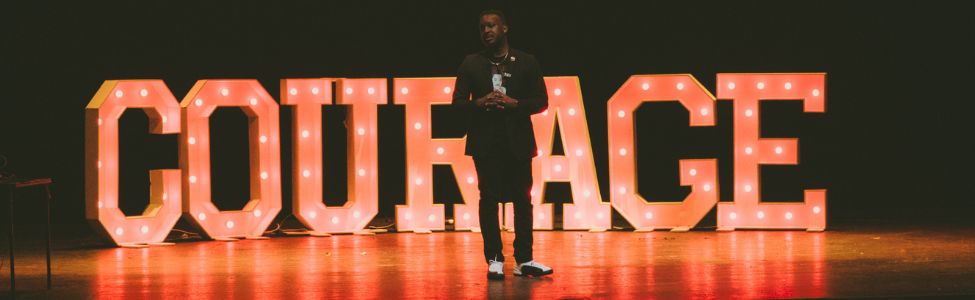
There is a particular kind of silence that settles over a room when someone speaks the truth without apology. Not the silence of discomfort — the silence of recognition. That is what filled Harold Washington Cultural Center on the evening of February 21, 2026, as five Black men prepared to take a stage they had been building toward quietly for months.
They were not there to campaign. They were not there to perform. They came to tell the truth about a city they love too much to lie to — and they let Chicago listen.
I caught each of them just before the curtains opened — in the charged stillness backstage, with the crowd settling into their seats and the jazz already warming the room. What they said in those moments before the lights came up was as honest as anything spoken from the stage.
The Ripple Effect Tour was Jahmal Cole’s idea, which surprises no one who has spent time around him. Cole, CEO of JC Enterprises, founder of My Block My Hood My City, and a survivor of gun violence twice over, has never been the kind of person who watches a problem from a distance. He saw a city full of people desperate to act and unsure where to begin.
So, Cole built them somewhere to begin. “Kings of Comedy, but more kings of community,” he said.
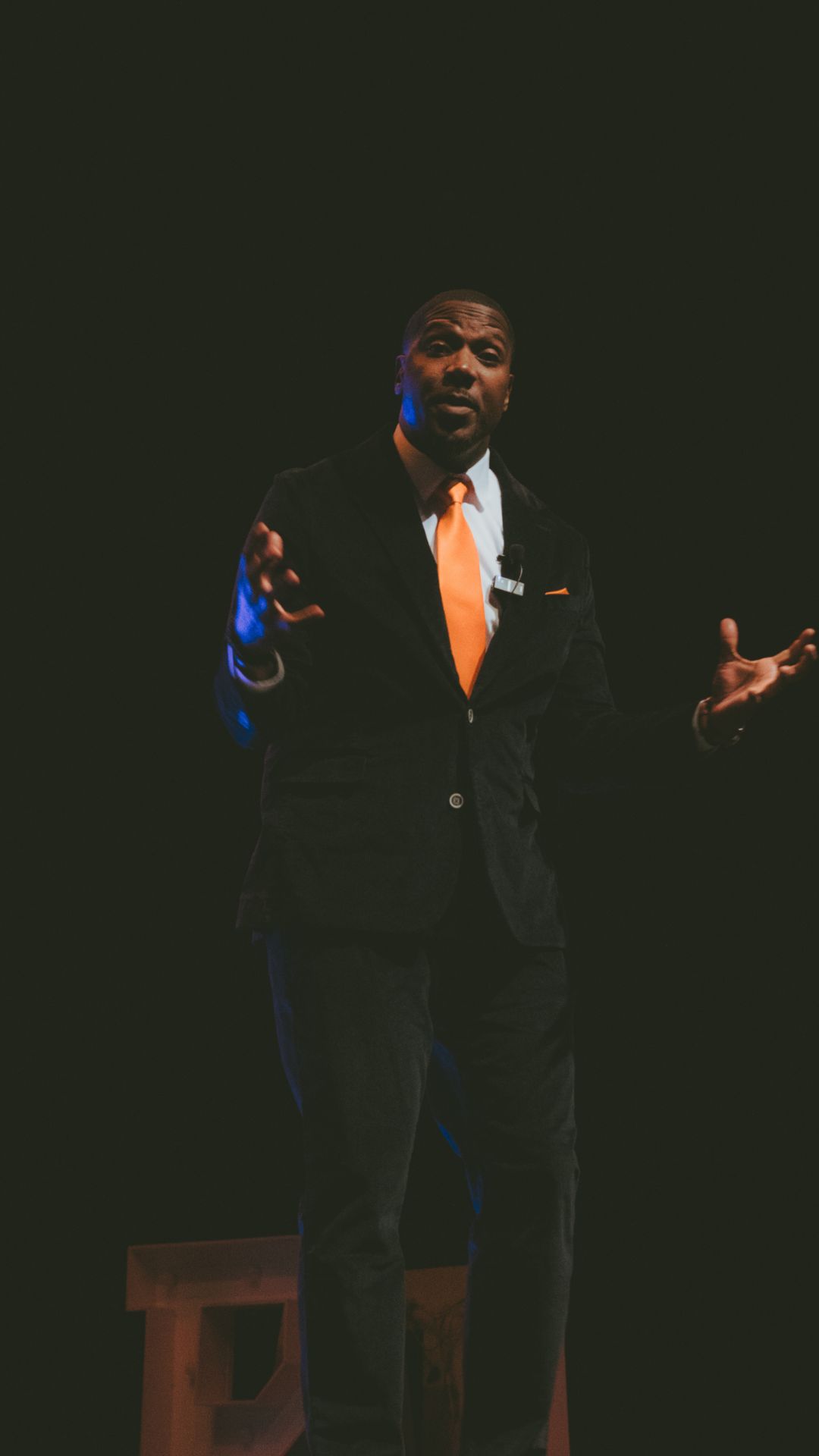
The comparison is not as casual as it sounds. The men he assembled have collectively raised tens of millions of dollars to fuel neighborhood initiatives across Chicago. For Cole, though, credibility has never been about money. It is about measurable, visible, undeniable impact. When Cole talks about violence prevention, he does not reach for policy language. He reaches for something more personal.
“It’s not just policing. It’s psychology. It’s the emotional weather of the city,” he said.
The name of the tour comes from a Robert F. Kennedy speech about ripples of hope — how each act of courage, however small, connects to the next until the current becomes a wave. Cole has made the metaphor something you can hold in your hand. Attendees left with stickers reading “Report Your Ripple,” each linked to a platform where Chicagoans can log what they are doing on their blocks. Cole wants to map hope. He wants to make it visible.
With support from Northwestern University and Wintrust Bank, the tour expands nationally in April 2026 to Baltimore, Atlanta, and Jackson, Mississippi. But Chicago is where it begins. Chicago is always where it begins.
The first call Cole made was to Christian Perry — political director for Mayor Brandon Johnson, founder of Black Millennial Renaissance, and the person Jahmal simply calls the glue. Perry accepts the title. He has earned it.
It was Perry who took the idea to the others, who gathered the names, who hosted the first dinner at his home. What followed were months of Saturday breakfasts and late evenings around a kitchen table — hard conversations, honest ones, the kind that build something sturdier than strategy. They built trust.
“This is us showing what has already been happening behind closed doors,” Perry said. “Five Black men who have dared to make their city a better place — not just as partners in protest, but partners in hope.”
His ripple for Chicago is the most communal of the five: a city that recognizes its own interdependence. One where people leave any room knowing they are responsible for the person who was sitting beside them.
With guests filing in and the curtains still drawn, I put the same question to each man: Where has Chicago fallen short, and who needs to own that?
Their answers arrived without hesitation.
Xavier Ramey, CEO of Justice Informed and director of the Chicagoland DEI Alliance, came with a structural diagnosis. Chicago, he said, does not have a plan for time. It has plans for elections. The investments that have transformed the Loop and the downtown skyline have come at a cost paid disproportionately by the neighborhoods furthest from it — and the city has never been fully honest about that arithmetic.
“We need to look at social progress like going to the gym,” Ramey said. “You’re never finished. And you can’t feel defeated because you’ve got to keep going.”
When the ripple question reached Ramey, he offered the most spiritually demanding answer of the night: “Humility.” “When you expect the mayor to fix something,” he continued, “that’s not hope — that’s pride. If you’re humble, you realize you have agency to be an answer.”
He paused, then said, “Humility is a hard thing to ask of people who are hurting. But it is the thing.”
Dion Dawson, chief dreamer and CEO of Dion’s Chicago Dream and Cosmic Crate, sees a city at a reckoning between two communities — business and neighborhood — that need each other and keep missing. The wage gap is widening. The middle class is thinning. And the moment, he believes, demands participation, not observation.
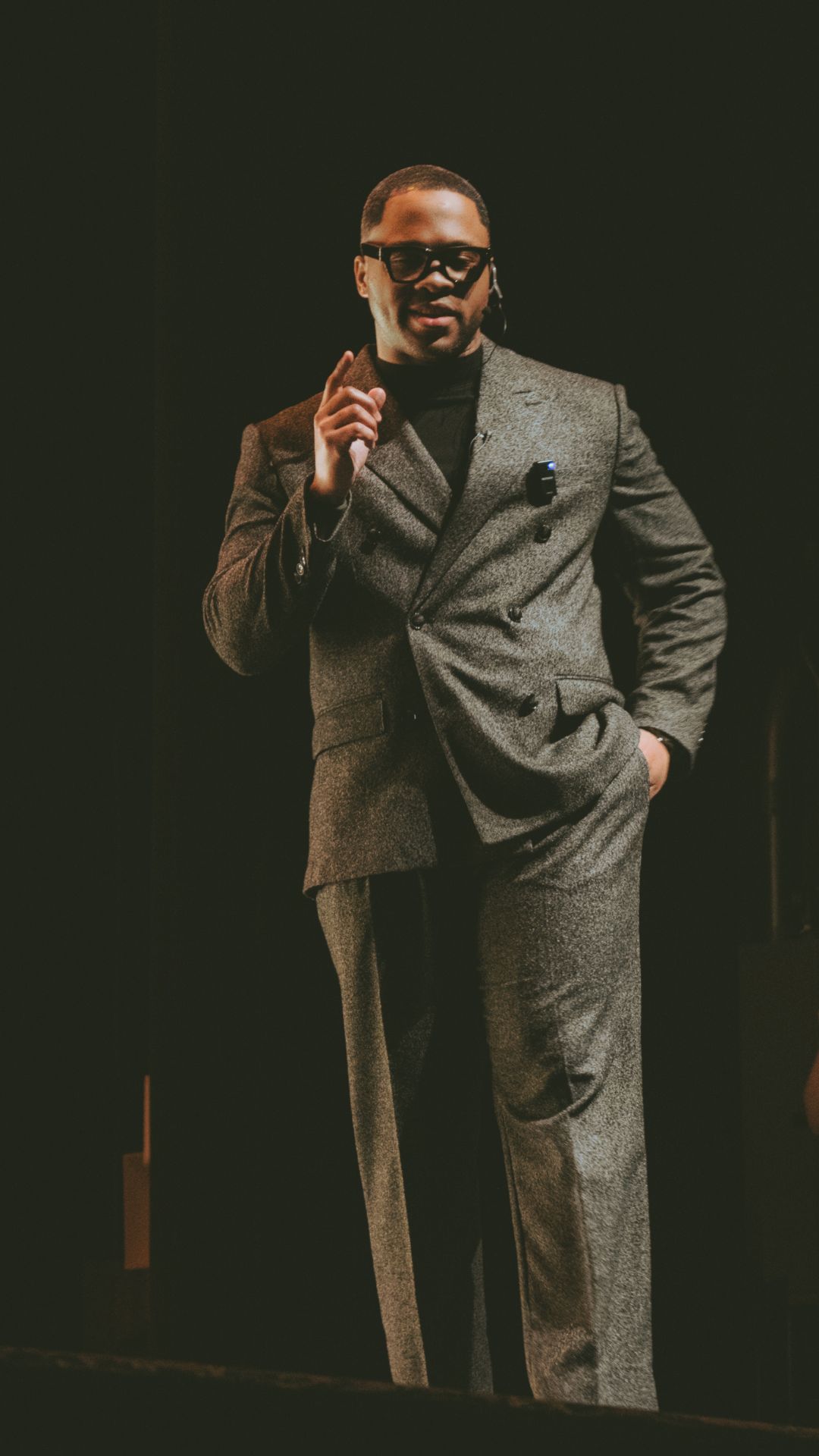
“Chicago’s always been a city of movements,” Dawson said. “We don’t get to be bystanders anymore.”
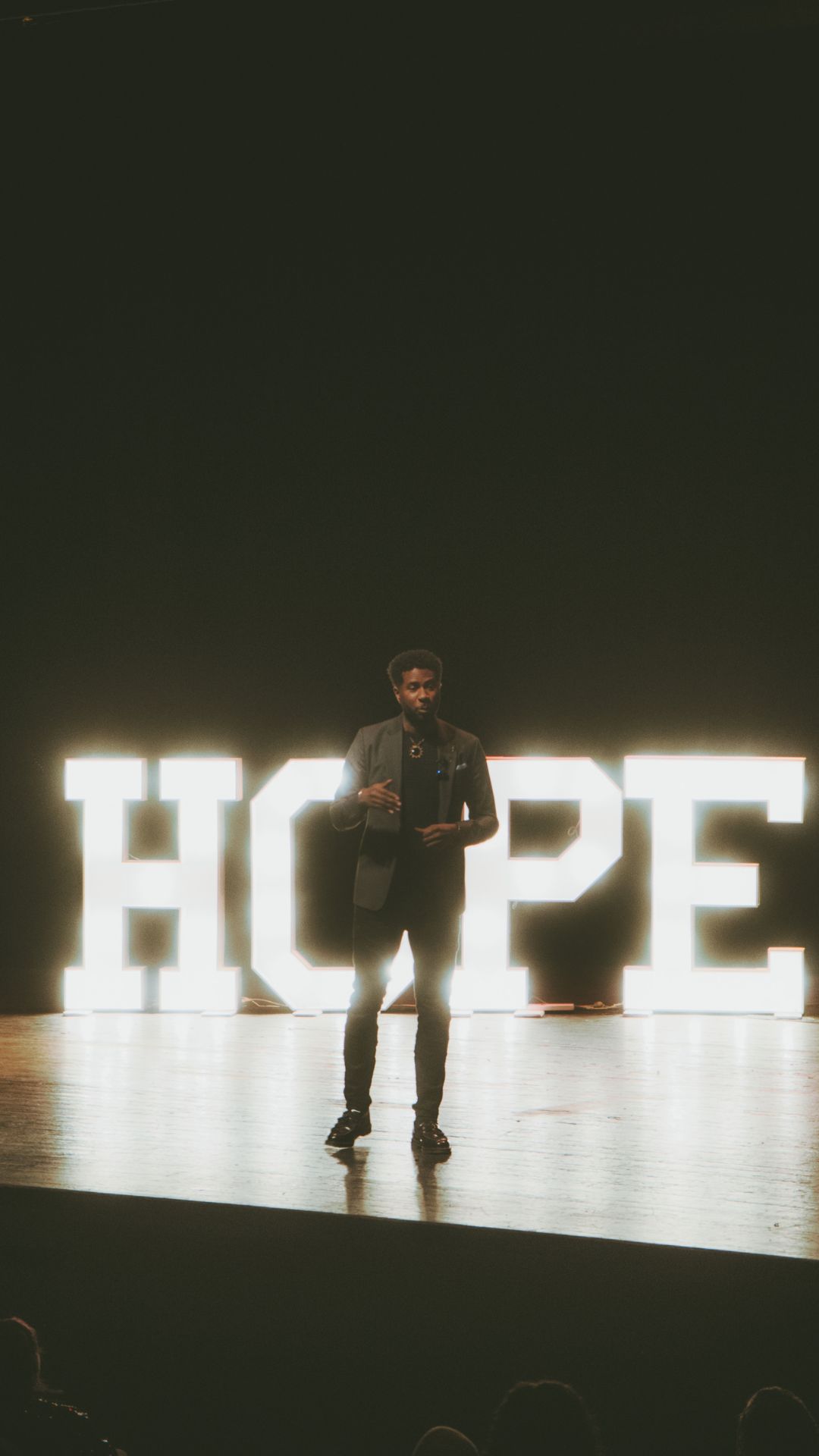
His tangible ripple: more Gen Zers of color running for office — not eventually, but now. He knows the talent is there. He wants to see it move.
Jamyle Cannon, founder and executive director of The Bloc, the North Lawndale nonprofit that channels young people’s aggression into boxing, refused the premise of the question entirely. Chicago has not fallen short, he argued. Chicago is full of people who already feel responsible. They simply do not know which direction to aim it.
“More than any other city I’ve encountered, people here feel a responsibility for what happens,” Cannon said.
Cannon, who came to Chicago from Lexington, Kentucky, in 2012, found a city already being reshaped by a man in a hoodie selling T-shirts and talking loudly about the community. That man was Jahmal Cole. Cannon has not forgotten it.
Cannon’s ripple was the quietest and perhaps the most demanding:
“When someone asks what you’re doing to make the world a better place … you have an answer,” he said.
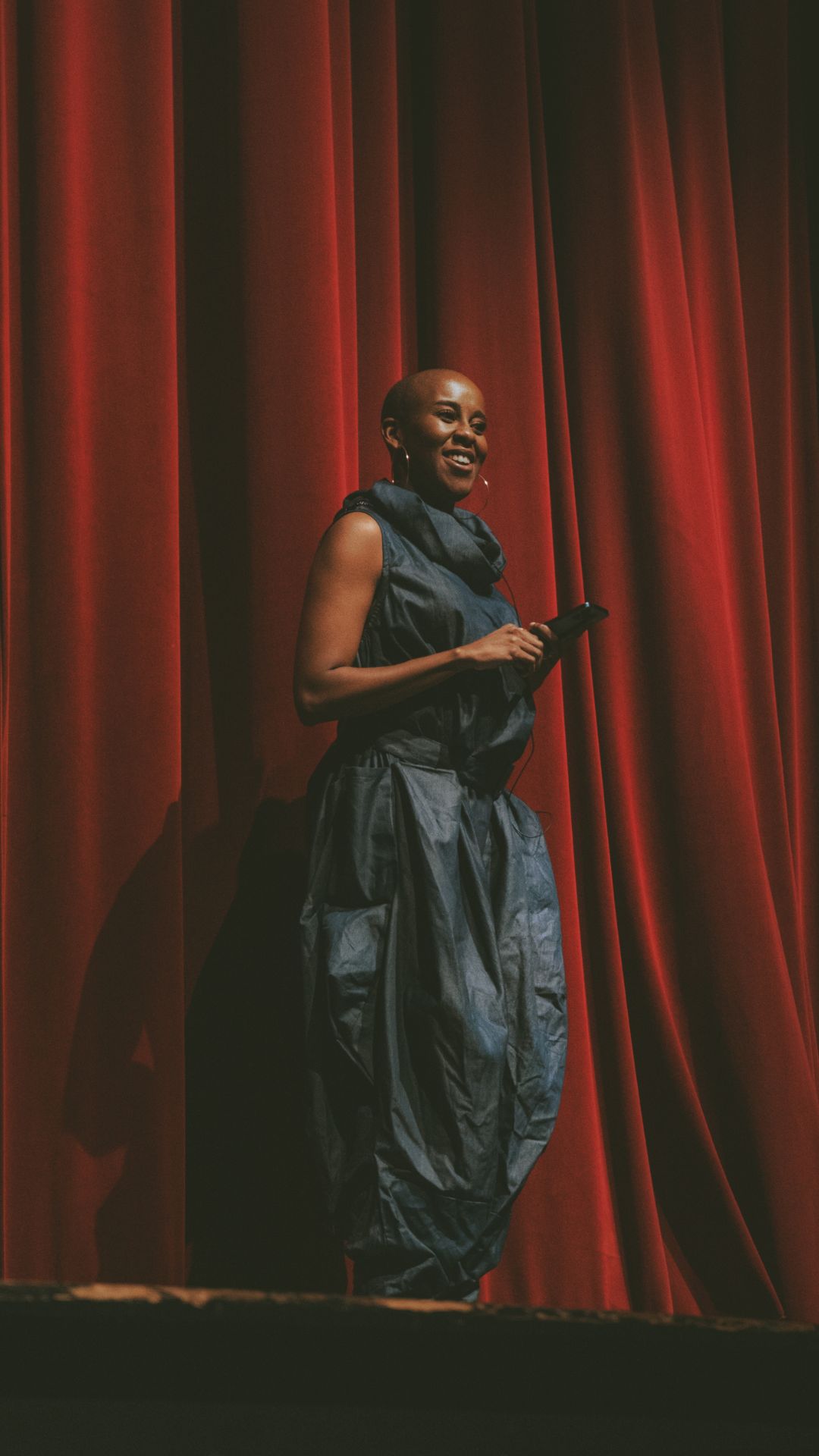
Threading through all of it — before the curtains, between the speakers — was Lisa Beasley. The Chicago-based comedian and independent artist known as the Lisa B Experience was not merely a host. She was the room’s emotional architect.
“I can hold space in any room, and I’m not afraid of the weight of any subject,” Beasley said. “I can bring levity. I know how to balance it with weight.”
Her instruction to the audience subverted every hosting convention. While others tell a crowd to leave their problems at the door, Beasley told them to do the opposite — to sit with their reality, to let the evening find them where they actually were.
Beasley ripple for Chicago was the sharpest thing said all evening, and perhaps the most necessary.
“Action. For real action. I don’t want to hear about anybody’s plans. I want to see it,” she said.
Five men. Five answers: humility, accountability, conviction, unity, action. Not contradictions. Components. Each one a different entry point into the same truth: that the city Chicagoans want already exists in the people willing to build it.
The Ripple Effect Tour did not begin when the curtains opened. It began at a kitchen table months ago, among five men who refused to keep their best conversations private. What happened at Harold Washington Cultural Center was simply the moment Chicago was invited in.

Dr. Mila Marshall is an environmental professional and journalist with a passion for advancing sustainability in all sectors. Her passion is directed towards urban food systems in segregated cities.