

There is a moment Dr. Sakira Jackson can name down to the details, including the day. It was April 11, 1998, and she was driving when a question arose with a force she could not ignore. “Whose life is this?” She remembers asking out loud. “It’s not mine,” she heard herself clearly say to her higher self.
What made the moment significant was not that her life looked empty. By then, she had a marriage, children, businesses, and responsibilities, the kind of life that reads as full, from the outside looking in. But what she understood in that instant is something many high-performing people come to realize much later, if ever. Success and alignment are not the same thing. A life can look complete and still feel disconnected by the person living it. That gap would eventually become the foundation of her work.
“Whose life is this? … It’s not mine.”
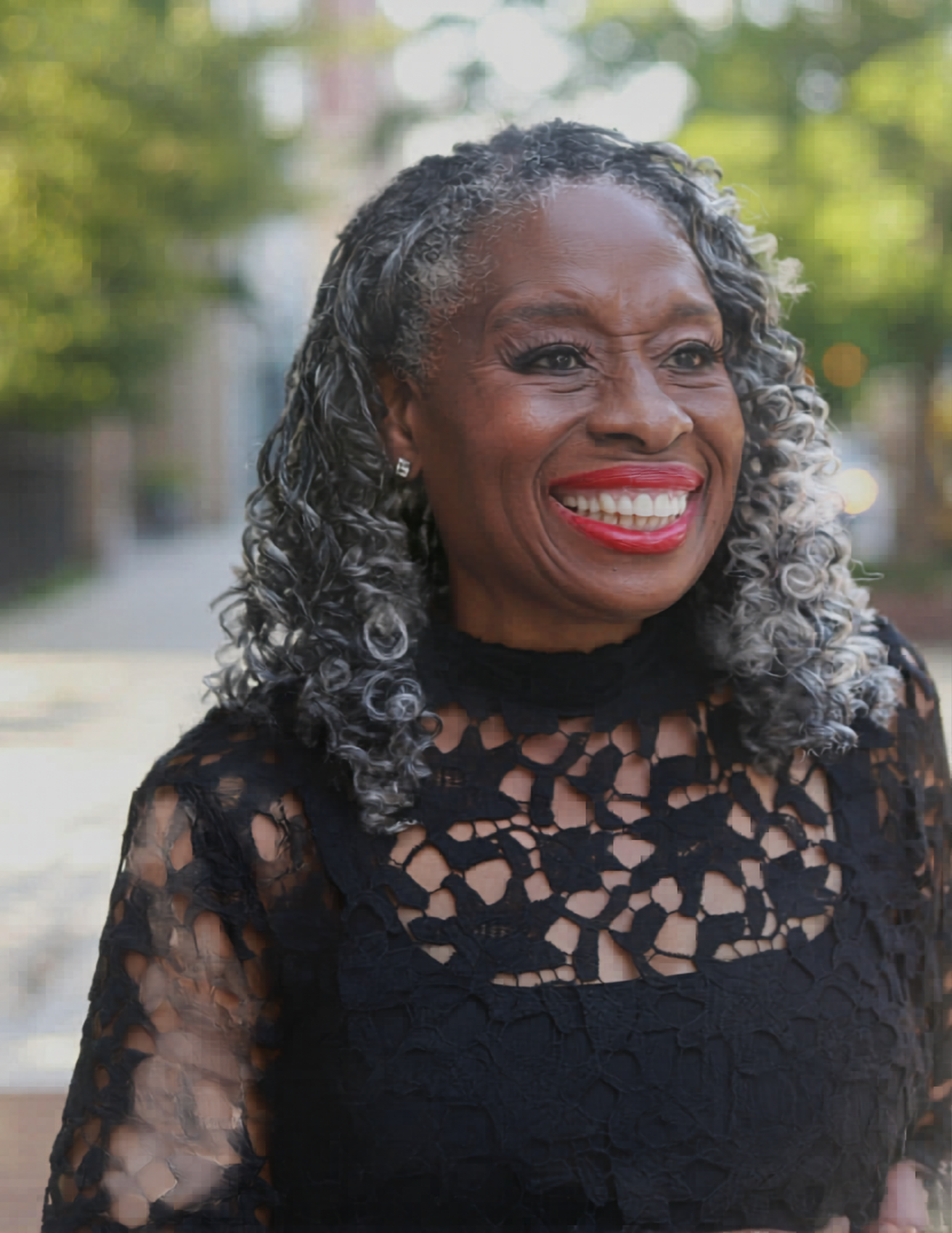
If you meet Jackson now, what stands out first is not force, but ease. Her presence feels composed, intentional, and fully her own. Her photos are vibrant, her style expressive, and she wears a smile that does not read as performance, but as comfort. There is nothing loud about her authority. It is steady. It shows up in the way she listens, in the clarity of her language, and in how she speaks about hard-earned lessons without needing to dramatize them. You sense everything about her is intentional without being performative. It’s genuine and authentic. What reads as ease today is not the absence of struggle. It is the result of someone who has done the work to become grounded within herself.
“I’m a little girl from the projects.”
Jackson says that without hesitation. She grew up in Springfield, Illinois, in the John Hay Homes, one of several children raised in a household shaped by both limitation and expectation. After her mother left her father when Jackson was 12, the structure of the home shifted, but the standards did not. She and her siblings were raised with discipline, responsibility, and a clear understanding that they were expected to think for themselves.
Her mother’s approach to learning was direct and unwavering. If Jackson asked what a word meant, she was told to look it up. If she still didn’t understand, she was expected to continue the pursuit until she achieved her end goal. That expectation molded more than her academic habits. It shaped how she moved through the world. She learned early that answers were not something you waited for. They were something you pursued.
Even as a child, there were signs that she was not entirely comfortable accepting things as they were given to her. At five years old, she asked her mother if she could change her name. The answer was no, but the instinct behind the question mattered. It reflected a belief that identity was not fixed, that it could be questioned, examined, and, when necessary, redefined.
“I just knew that the existence I was living was not my life,” she says. That awareness did not come with a plan, but it did come with direction. By 13, she had already found her way into a job, determined to create options for herself. When her mother told her that college was not financially possible, Jackson made a decision that would define how she approached obstacles moving forward. “I forged her name on the paperwork,” she says. It was not an act of rebellion. It was a declaration of refusal.
Around that same time, a psychology class introduced her to a way of thinking that felt both new and familiar, hence two things can be true at the same time. An assignment meant to be three pages became twenty-seven. “I knew at that moment that there was something about that field,” she says, “that connected with me. The instinct was there long before the credentials.”
“I thought that’s what love was.”
Jackson married young, and the violence, she says, began almost immediately. By the second or third day of the relationship, he had already hit her. What followed was a 22-year abusive marriage, though at the time she did not yet have the clarity or distinction to fully name it that way. What she was experiencing did not feel foreign. It felt familiar.
“I thought that’s what love was,” she says again, this time with the clarity of distance.
Even within that reality, she continued to build. She raised children, created businesses, and moved through life with a level of productivity that concealed what was happening beneath the surface of who she was being. But functioning is not alignment. A person can be effective and remain disconnected from themselves.

The shift came in a moment that she still remembers clearly. “And something inside of me said, no,” she recalls.
Not long after, that clarity sharpened into something undeniable. On April 11, 1998, while driving, the question returned, this time with an answer attached. “Whose life is this? It’s not mine.”
“What I did know is that I was no longer going to have the life that I had.”
That eventful of realization came with undeniable clarity. Yet the moment of leaving did not come with a detailed plan. It came with a decision. Jackson says she gave up everything—the car, the furniture, the life they had built—not because those things didn’t matter, but because peace mattered more. She was willing to figure out what came next if it meant she no longer had to live inside what she had already outgrown.
What followed was not immediate reinvention, but reconstruction. After the divorce, she spent two years in therapy, twice a week. “I had to learn how to love me,” she says. Before there was a framework, there was ‘the work.’
In the years that followed, she also found love again. “I actually met him online on BlackPeople Meet,” she says, recalling how they met in person on July 23 and married on that same date the following year. “We’ve been married ever since.” She speaks about that relationship with a kind of grounded certainty. “My husband is this person that I… I know God knew what he was doing,” she says.
It is in the smaller details that she describes him most clearly. At one point, she mentions that he built her a greenhouse while he was in a wheelchair. “No, he’s wonderful,” she says, almost brushing past it. The image lingers—a quiet act of care, constructed piece by piece, in a life she once thought might never hold that kind of steadiness again.
“I ran myself into the ground.”
Long before her current work took shape, Jackson had already built multiple businesses, navigating growth through experience rather than instruction. One venture expanded into a private label manufacturing company with 10,000 square feet and 50 employees. She secured major contracts, created large-scale activations, and built momentum in spaces where she was often the first.
From the outside, it looked like success.
Internally, it came at a cost.
“I didn’t know what I didn’t know,” she says.
She knew how to build. What she had not yet learned was how to build in a way that sustained her. Some opportunities worked. Others did not. She speaks openly about losses, including the financial impact of producing a large-scale Super Bowl event that did not return what she expected.
“I ran myself into the ground,” she says again, now as instruction.
What Jackson came to understand is that success, when it is built from survival rather than alignment, will eventually ask to be reexamined.
“What they don’t talk about is the soul.”
Her work as a consultant exposed a pattern that extended far beyond her own experience. Business owners came to her for strategy, systems, and solutions. And while those things mattered, they rarely addressed the deeper issue.
“What they don’t talk about is the soul,” she says.
The issue wasn’t information. It was alignment.
Many of the leaders she works with have already built something successful, but what they’ve built often reflects a version of themselves they’ve outgrown. When identity, decisions, and direction no longer match, friction shows up everywhere.
“What creates friction isn’t a lack of knowledge,” she explains. “It’s a lack of alignment between identity, decisions, and direction.”
Instead of leading with strategy alone, Jackson focuses on recalibration. Because once the internal shift happens, everything else begins to move differently. Decisions become clearer. Leadership becomes more grounded. Growth becomes more intentional.
“The internal shift drives the external results,” she says the precision of an exacto Knife.
She describes her work as sitting at the intersection of business, behavior, and belief. It is not just about what a company does. It is about how the person behind it thinks, what they believe, and whether the life they are building actually belongs to them.

“My job is to bring clarity.”
Jackson is also clear that her work is not simply about helping people grow businesses. Now approaching the 10-year anniversary of her Intentional CEO Mastermind, she has refined a model that asks deeper questions about structure, sustainability, and legacy. Through initiatives like Solomon’s Council, her invite-only advisory circle, she works with leaders who are not just looking to scale, but to build in ways that reflect who they are now.
For Jackson, business is never just business. It is an extension of belief, behavior, identity, and stewardship. “I need the psychology of business. I need the biblical business principles that God already set down so I can help people bring those tools into their business practice,” she says.
In her view, the Bible is not separate from business. It is structure. It is instruction. It is stewardship. It is a framework for how to lead, how to build, and how to sustain what you create. And at the center of it all is ownership—not restricted to a company, but the center of a life.
Her backstory gives weight to that belief. She is not speaking from theory, but from a life that required her to rebuild more than once. She knows what it means to perform from strength while carrying private pain. She knows what it costs to build without alignment. And she knows what becomes possible once a person tells the truth about their life and chooses to live differently.
For years, the question followed her as she continued to build a life thas she could call hers.
Whose life is this?
Now, the answer is no longer complicated.
She lives her life.
And this time, it fits.