

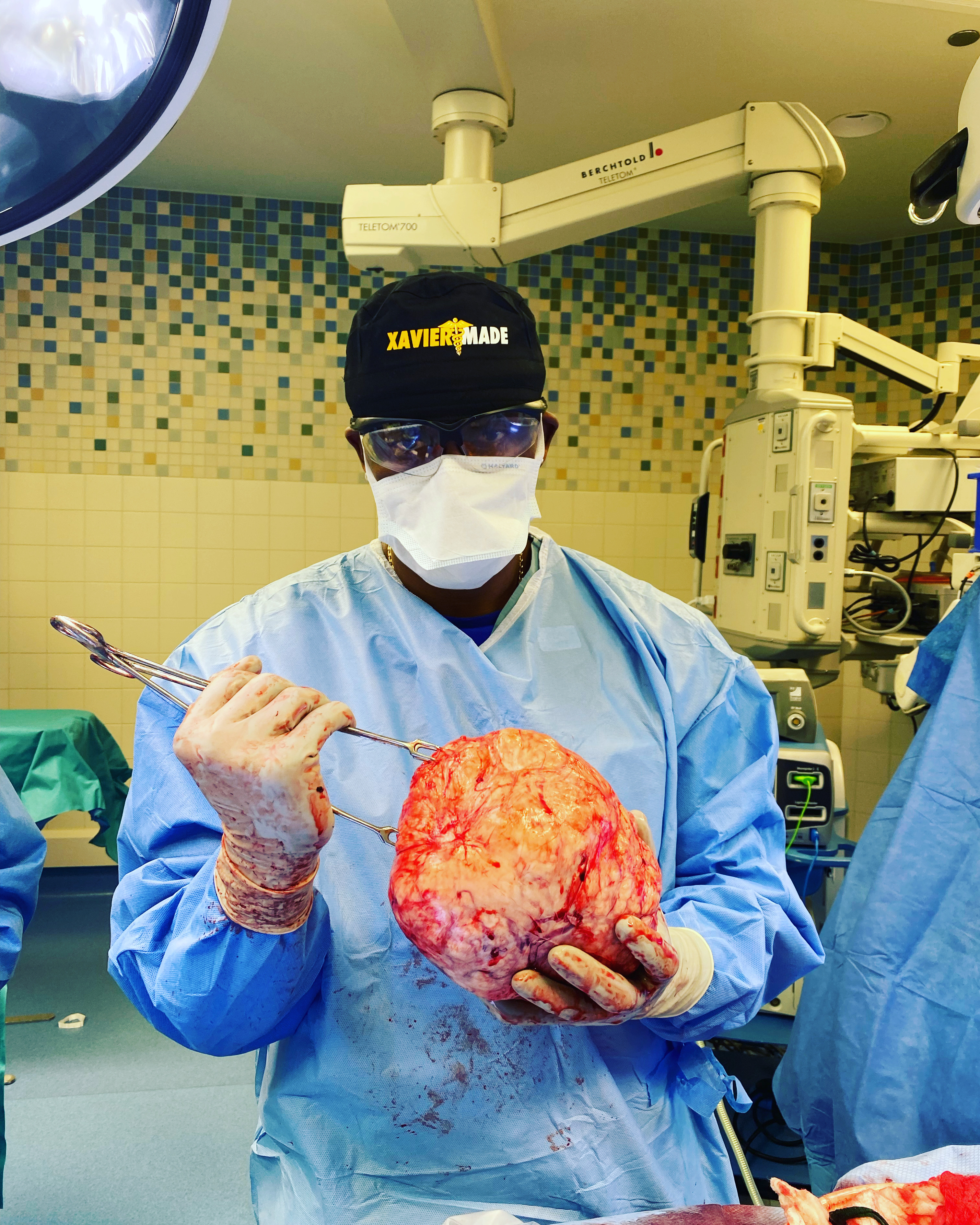
Dr. Pierre Johnson is known as ”The Fibroid Slayer,” but the deeper story is about a South Side surgeon whose life complicates what circumstance is supposed to predict.The cap says ”Xavier Made” in gold letters. The scrubs are blue. The gloves are bloody. And in his hands, Pierre Johnson holds something the size of a bowling ball, a 27-pound fibroid he just removed from a pregnant woman who had been told she might lose everything, her uterus and her baby.
He is looking directly at the camera. He looks exactly like himself.That is the whole story, really. But it deserves to be told properly.In conversation, Johnson moves the way Omega men tend to move, with an ease that disarms you before the substance lands. He is quick to laugh, quicker to make you feel like you are talking to someone who already knows you. Then women’s health comes up, and something shifts. The charm does not leave. It just makes room for something harder and more urgent.
The Odds and the Outcome
Known nationally as ”The Fibroid Slayer,” the Chicago-born surgeon has built a reputation for treating some of the country’s most complex fibroid cases. Patients travel across state lines and international borders seeking his expertise. Johnson’s work inside the operating room has given women hope in moments when they were told their options had narrowed.
By most measures, Johnson is exactly what success looks like. And yet none of those accomplishments fully explain what makes him remarkable. The public story begins with the surgeon. The deeper story begins with the odds. The case at Loretto Hospital was the intersection for those two stories melding them into one. A pregnant Black woman sought another opinion after being told she could lose both her baby and her reproductive organs. She chose a second opinion. She chose Pierre Johnson.
The surgery that followed removed a 27-pound fibroid while preserving both the pregnancy and her uterus. It becomes a visual argument against inevitability.
He grew up in Chatham, the eldest of five children, in a family shaped by addiction and instability. His parents struggled with drugs. His educational experience moved between higher-access suburban schools and underperforming schools. Because of the logic of social prediction, his future should have been easier to chart. Yet Johnson kept imagining himself beyond the limits of what surrounded him. ”I’m just one of those driven people,” Johnson told CNW. ”When I’m speaking into the atmosphere, when I put my mind to it, it’s going to be done.”
The Boy Who Saw the Doctor
Long before he became the physician women now seek out for complicated gynecologic cases, Pierre Johnson was a kid from Chicago who wanted to play professional basketball and happened to watch the right show on the right night. On The Cosby Show, he saw Dr. Cliff Huxtable, a Black man who was educated, respected, professional and, perhaps most importantly for Johnson’s imagination, an OB-GYN.
For many viewers, Cliff Huxtable was a character. For Johnson, he was a door.
”The only really positive Black male role model that I saw at that point was Bill Cosby,” Johnson said. ”He happened to be an OB-GYN.”
A child watched television and saw a version of manhood and medicine that made the future feel possible. He saw an image and absorbed its possibility before anyone had the chance to tell him how difficult the road would be. Johnson remembers being challenged by an aunt to think beyond basketball and offer a Plan B. He answered that he wanted to be a doctor.
”So literally as a 5-, 6-year-old kid, that was it,” Johnson said. His goals did not shrink as he got older. They expanded. ”My goal was not to be a well-known, respected doctor in Chicago alone,” Johnson said. ”That’s not enough for me. It has never been enough for me. My goal was to be able to offer the skills and to be able to operate and to help women all over the world.”
Today, that vision no longer sounds theoretical. Women have reached out from Russia, Norway, Finland, the Caribbean and Africa. Patients travel from Los Angeles, New York, Miami and Atlanta to Chicago’s West Side for surgery. ”They’ve come out west for surgery from this Black kid from the South Side of Chicago,” he said.
The Road Was Not Built Smooth
In The Pulse of Perseverance, co-authored with two fellow Black physicians, Johnson writes about a young man who knew what he wanted early but kept encountering moments that forced him to adjust, regroup and begin again. The book traces how three Black men from different states reached medicine despite the absence of easy pathways. The project that followed turned their testimony into scholarships, mentorship, and a mobile platform connecting aspiring professionals with people who had already walked into the rooms they were trying to reach.
”We’ve given almost $100,000 in proceeds from the sales of that book,” he said. The work did not stop with the book because Johnson’s own life had taught him that inspiration without access has limits. That is the purpose behind P3.
”If they don’t see it, they can’t achieve it,” he said. His mother’s transformation remains central to the way he thinks about possibility. Her addiction shaped his childhood, but her recovery helped sculpt his understanding of human resilience.
”My mom is the greatest source of inspiration in my life,” he said. ”Watching her transformation from struggle to triumph has been the biggest inspiration for me, a catalyst for my success.”

The Surgeon Who Did Not Assimilate
Part of what makes Johnson compelling is that he does not read as a man who assimilated into medicine by stripping himself of everything that made him recognizable. He is still visibly and unmistakably himself, the earring, the tattoos, the South Side cadence, the directness. He did not become a doctor by pretending not to be the kid from Chatham. He became a doctor with that kid still intact.
His life includes being a fraternity brother, a son, and a father. Johnson’s Omega Psi Phi membership is not incidental to who he is in a room. Neither is the family he built, particularly for a man who grew up without the stability of one. It is all part of the same through line: a man who collected belonging wherever he found it and carried all of it into medicine with him.
Johnson connected part of his surgical precision to an unexpected place: barbering. He started cutting hair when he was 14 and worked in a shop before entering medical school. Over time, the coordination and respect for small movements parlayed into his surgical life.
When other doctors hesitate over size, Johnson leans into his overwhelming desire to its complexity.
”We Always Have Options”
Johnson’s medical focus is deeply tied to uterine fibroids, a condition that disproportionately affects Black women, who often encounter delayed diagnoses or treatment plans that make hysterectomy feel less like an option and more like a foregone conclusion. What he challenges is the absence of full, informed conversation.
His measure is not whether fibroids can ever return, since they can as long as a woman has a uterus. His measure is whether his patients need another surgery after he performs the initial operation.
”To date, I have not had to re-operate on anyone that I’ve done one primary fibroid surgery,” he said, contrasting that with a national average of about 40 percent. ”I’m at a zero right now.” When he talks about patients, the register changes completely. The warmth is still there, but it’s load bearing now, holding up something serious underneath. ”It’s about education and understanding what the options are and what makes sense,” he said. He encourages patients to seek second, third, or even fourth opinions. He tells women to research their surgeons, ask questions and trust the discomfort that tells them something may not be right.
”When you are going into surgery, you are completely helpless,” Johnson said. ”You cannot advocate for yourself. You cannot speak for yourself. So, you choose the absolute person who you will literally put your life in their hands. That has no loyalty, that has no allegiance.”
When asked what he would say if everyone had his attention, Johnson did not offer a soft answer. ”I would say that number one; we always have options,” he said. ”Don’t let anybody tell you that you don’t have options.”
One of One
Johnson’s answer has been built. He built a surgical reputation around cases others considered too large or too complex. He built a public platform that translates medical knowledge into language people can understand. He helped build a book into a nonprofit mission and a mentorship app because one example changed his life, and he does not want the next child to have to wait for a sitcom to see a future.
His story does not deny the force of one’s environment, class, access, or race. It proves those forces exist while insisting they are not the whole story.
”I am one of one,” he said. The most interesting part of Johnson’s life may not be that he became one of one. It may be that he is working so hard to make sure he is not the only one. For Johnson, the dream did not change. It just got bigger.