
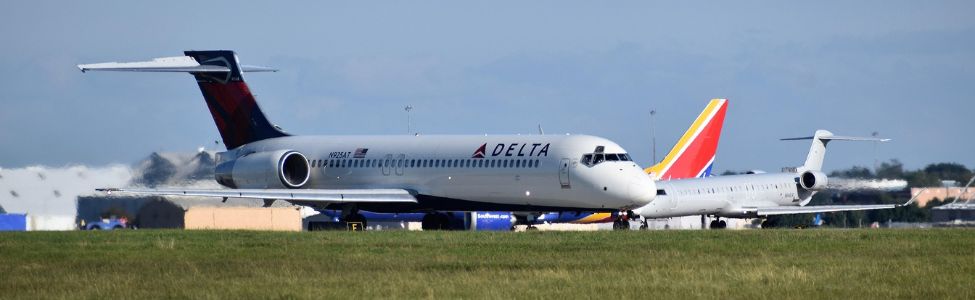
Somewhere in Washington, a senator had to wait in a regular line at an airport. And the country finally paid attention to the shutdown.
Delta Air Lines announced Tuesday that it is suspending special services for members of Congress, including airport escorts and certain VIP rebooking assistance — a pointed response to the partial government shutdown that is now nearing 40 days. The shutdown began February 14, when funding for the Department of Homeland Security lapsed, leaving the Transportation Security Administration operating on emergency footing. For the country’s legislators, the consequence was an inconvenient Tuesday at O’Hare or Dulles. For everyone else, it has been something considerably more serious and considerably less covered.
“A Transportation Security Officer selling plasma to keep the lights on is unconscionable.”
— Everett Kelley, President, American Federation of Government Employees
This is the third shutdown to hit DHS workers in less than six months. Roughly 50,000 airport security officers are working without pay, while more than 61,000 TSA employees are classified as essential overall — meaning they are legally required to report to work whether or not they are being paid.
Absenteeism has climbed sharply. On some recent days, callout rates have hovered around or above 10 percent nationwide, with thousands of officers missing shifts as financial strain deepens. At least 458 TSA officers have quit since the shutdown began, according to DHS.
Union representatives and agency officials say the impact has been immediate and personal: workers taking on second and third jobs, applying for food assistance, sleeping in their cars, facing eviction notices, and in some cases selling plasma to cover basic expenses.
O’Hare International Airport is the busiest in the United States by aircraft operations. It is also a major employment hub for Chicagoans — particularly Black and immigrant workers in food service, ground operations, cleaning, and security. A sustained DHS disruption does not stay at the terminal. Chicago’s immigrant communities are now navigating a bureaucratic instability that historically lands hardest on the people with the least institutional access to navigate it.
“Most employees live paycheck to paycheck … This is unsustainable.”
— Johnny Jones, Secretary-Treasurer, AFGE TSA Council 100
This is not the first time TSA workers have absorbed the cost of congressional dysfunction. Many had barely recovered financially from the last shutdown when the DHS lapse began again in February. The machinery of the country’s aviation system is being held together by people the government has decided it can ask to work for free.
Delta’s move generated a news cycle. The workers who showed up without a paycheck did not.
Nobody will pull their perks for that.