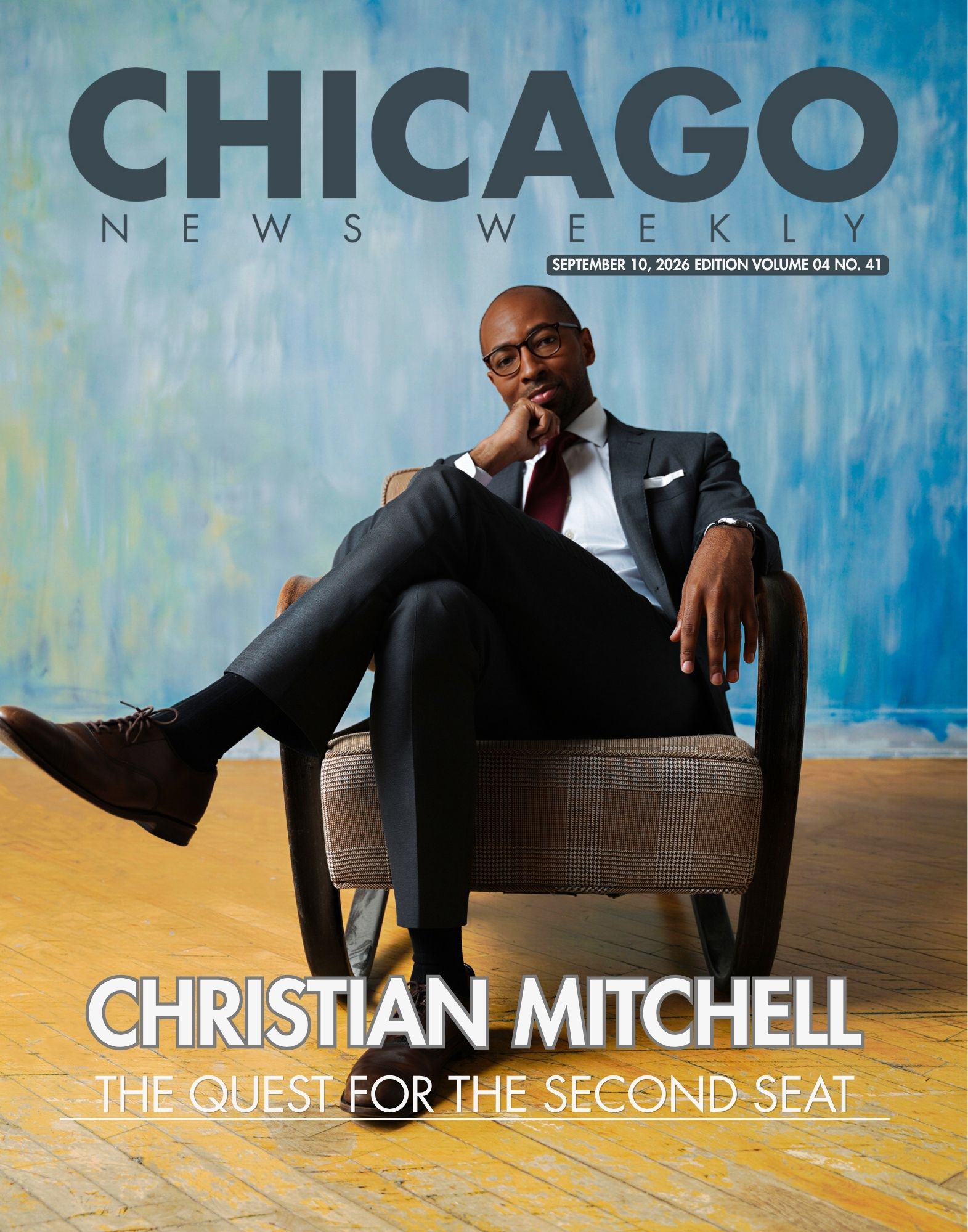
Christian Mitchell arrived for his Chicago News Weekly cover shoot wearing his grandfather’s Army dog tags. It was his first major photo shoot, an admission he made with the mild embarrassment of someone more accustomed to standing beside the person being photographed. The cameras made him feel awkward. The dog tags did not.
His grandfather, James Gist, stood “in the gap” after Mitchell’s father left when he was young. A union steelworker with an eighth-grade education, Gist worked at Reynolds Metals near the Stevenson Expressway and became the father in Mitchell’s house. Wearing his dog tags brought the private architecture of Mitchell’s life into a decidedly public moment.
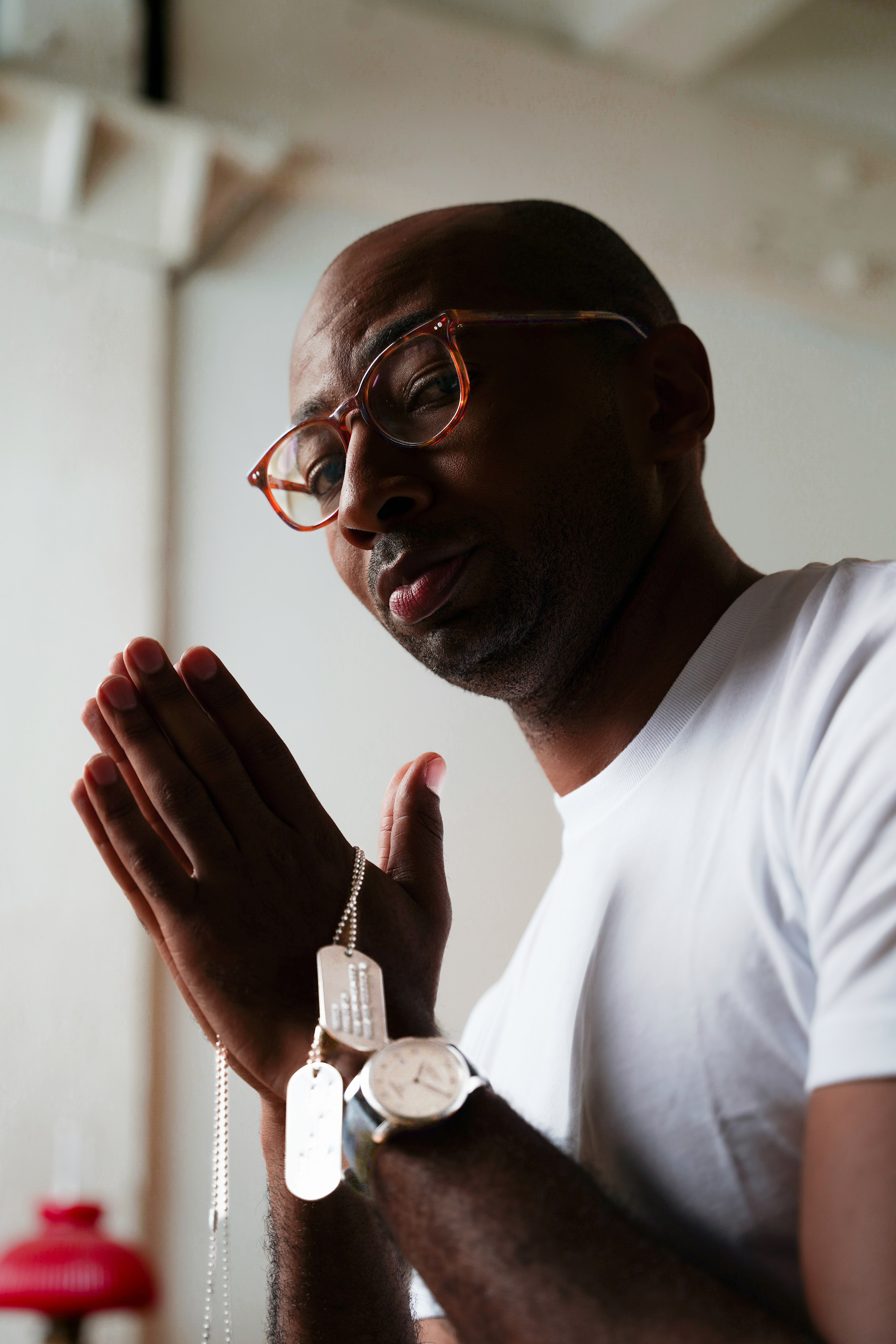
“My mother is my hero, but my grandfather really stood in the gap for me,” he said. “I wear those tags on days when I need good luck or I wear them on days when times are hard.”
The photograph captures something useful about Mitchell’s candidacy for lieutenant governor. He is stepping into a campaign built around the considerable political identity of Gov. JB Pritzker, but he wants voters to understand the people and experiences that shaped him before Pritzker selected him as a running mate.
His biography is filled with institutions that confer authority: the Illinois House, the governor’s office, the Democratic Party of Illinois, the University of Chicago and the Illinois Air National Guard. Yet when asked to explain himself, Mitchell begins with Debbie’s son and James’ grandson.
Mitchell represented Illinois’ 26th House District from 2013 until 2019, became the first Black executive director of the state Democratic Party, served as one of Pritzker’s deputy governors and later joined the University of Chicago as vice president for civic engagement. In 2023, he entered the Illinois Air National Guard as a judge advocate, a decision inspired partly by his grandfather’s military service.
Mitchell once wanted to become an F-16 pilot, but his eyesight disqualified him. Decades later, while overseeing the National Guard as part of his deputy-governor portfolio, he spoke with then-Adjutant General Richard Neely about joining. Mitchell protested that he was already 36. “He said, ‘Well, I know the guy who signs the waivers because it’s me,’” Mitchell recalled.
As a judge advocate, Mitchell has provided legal assistance to Guard members, including preparing wills and trusts for those facing deployment. The experience reinforced his belief that people who disagree politically can still be required to trust one another when called to serve.
“When I go to the National Guard, a whole bunch of people, I’m quite sure, are not voting for me and don’t vote Democratic, and we still work together,” he said. “We get each other’s backs, and if we’ve got to go overseas and go downrange, we are going to make sure that flag on our shoulder is more important than any differences that we may have.”
Mitchell speaks about public policy with the patience of someone who has watched his ideas fail before watching versions of them return under different bill numbers, sponsors and governors. During his six years in the Illinois House, several of his most ambitious proposals stalled or were vetoed. He now describes those losses as an education in how government changes.
One of the clearest examples is teacher pay. Mitchell was the principal House sponsor of Senate Bill 2892, which would have raised Illinois’ statutory minimum teacher salary from $9,000, where it had remained since 1980, to $40,000 over several years. The General Assembly passed it in 2018, but Gov. Bruce Rauner vetoed it, and lawmakers failed to override him.
In 2019, after Mitchell entered the Pritzker administration, lawmakers passed House Bill 2078, which phased the minimum salary up to $40,000 for the 2023-24 school year. The new measure accomplished the central goal of the bill Mitchell had carried, although it was separate legislation. The original bill was sponsored in the Senate by Andy Manar, carried in the House by Mitchell and vetoed by Rauner in 2018.
“I passed a bill to raise the minimum wage for teachers through both houses,” he said. “Governor Rauner vetoed that bill. Later, that bill got passed when I was deputy governor and then (Gov) JB Pritzker was in office, and now it is the law of the land.”
Mitchell also introduced the Fund Education First Act, an unsuccessful proposal to prioritize elementary and secondary education in the state budget. He later participated in the broader legislative effort that produced Illinois’ evidence-based school-funding formula in 2017, although his bill was not the measure that ultimately became law.
His early cash-bail proposal followed a similar path. In 2017, Mitchell introduced House Bill 3421, the Equal Justice for All Act, which sought to eliminate monetary bonds while allowing judges to detain people considered dangerous. The bill did not pass. Illinois later eliminated cash bail through the Pretrial Fairness Act, part of the SAFE-T Act enacted in 2021 and implemented in September 2023.
“One good example is I was the first person to introduce a bill to end cash bail,” he said. “What’s important about that is not, ‘Oh my God, we’re letting everybody out.’ It is: Is what’s keeping you in prison about risk, about danger to the public, or is it about your ability to pay?”
Mitchell also co-sponsored a 2015 bill to decriminalize possession of up to 15 grams of cannabis. Rauner returned it with changes, and Illinois enacted a narrower decriminalization law the following year. Mitchell later helped the Pritzker administration negotiate the 2019 law legalizing adult use, establishing expungement procedures and directing a share of cannabis revenue toward communities disproportionately harmed by drug enforcement.
“None of that happens without some of those failures, some of those setbacks and learning how to overcome them,” he said.
As of July 2026, Illinois State Police reported expunging more than 780,000 qualifying cannabis charges. The social-equity licensing process, however, has faced delays, litigation and criticism over whether ownership opportunities reached the communities most harmed by cannabis enforcement.
“Sometimes your role is to start the conversation and sometimes your role is to finish it,” he said. “You’ve got to do the work, build the coalition, put in the time, and then over time you can see real progress. But you’ve got to be willing to take incremental change as well as take the big swings.”
“Deputy governor” sounds like an office one campaigns to win. In Illinois, it is an appointed senior staff position, closer to a high-level manager than a constitutional successor. Under Pritzker, several deputy governors divided major agencies and policy areas among them.
Mitchell’s portfolio included infrastructure, energy and public safety. He coordinated agencies including the Illinois Department of Transportation, State Police, Department of Corrections, Environmental Protection Agency, National Guard and Capital Development Board. According to the Pritzker administration, he played a central role in negotiating the Climate and Equitable Jobs Act, overseeing the Rebuild Illinois capital program, implementing cannabis legalization and advancing the state’s assault-weapons prohibition.
His clearest policy imprint may be on the Climate and Equitable Jobs Act. Mitchell represented the governor in negotiations among lawmakers, utilities, environmental organizations, labor unions, consumer advocates and nuclear-energy interests. The 2021 law established a path toward carbon-free electricity, expanded renewable-energy programs, funded workforce development and set closure deadlines for fossil-fuel power plants.
The negotiations also helped produce Mitchell’s reputation as a forceful operator. Veteran Illinois political reporter Rich Miller wrote that Mitchell became known in Springfield for an “in-your-face negotiating style” and fierce loyalty to Pritzker. Miller reported that Mitchell angered powerful participants during the energy negotiations, although the bill ultimately passed.
Mitchell has since conceded that determination sometimes crowded out diplomacy. Asked by Miller whether he had relationships to repair, he acknowledged there were times when he spoke when he should have listened. He said leaving government in 2023 changed him and promised to approach former adversaries with greater openness.
Former state Rep. Mike Zalewski, a western and southwestern suburban lawmaker who sat beside Mitchell in the Illinois House, said Mitchell’s reputation for sharp elbows must be considered alongside the demands of his former job. Deputy governors are required to make difficult decisions about policy, personnel and agency administration, Zalewski told The Illinoize, and Mitchell had been assigned an unusually heavy portfolio.
Taken together, the assessments produce a more complicated portrait.
Mitchell was trusted with consequential work because he could withstand conflict, but the qualities that made him useful behind the scenes may require adjustment in an office that asks him to build a public constituency of his own.
Mitchell also oversaw implementation of Rebuild Illinois, the approximately $45 billion capital program that invested in roads, bridges, public transit, universities and broadband. The assignment required him to coordinate agencies responsible for turning a sprawling legislative package into visible projects across the state.
Mitchell is now seeking an office whose influence depends heavily on the governor. The lieutenant governor is elected and stands first in the line of succession, but the office possesses relatively few independent constitutional powers. Its practical importance is determined by the responsibilities a governor is willing to delegate.
Mitchell’s greatest advantage is also the central difficulty of his candidacy. He knows the Pritzker administration from the inside, but the achievements he cites are inseparable from the governor whose name appears above his on the ticket. He must persuade voters that years spent beside power gave him more than proximity to it.
He says he wants to continue Lt. Gov. Juliana Stratton’s work with agriculture, rural affairs and community development while focusing on economic growth, workforce preparation and the everyday experience of dealing with state government. He points to a University of Chicago partnership with Malcolm X College that creates pathways from associate degrees into life-science careers. He also talks about improving routine interactions, from securing a professional permit to applying for help from the Department of Children and Family Services, because those encounters shape how residents understand government.
“Those may sound like little things,” he said, “but all those added up help bring life and vitality to our communities.”
Mitchell was not a child who always expected to enter politics. In 2004, he was playing a computer game with the television running in the background when Barack Obama walked onto the stage at the Democratic National Convention.
A young state senator began speaking about Illinois as the land of Lincoln and the crossroads of a nation. Mitchell heard the cadence and turned toward the television.
“In my lifetime, I’d never seen somebody like that,” he said. “That speech changed the trajectory of my life.”
He recognized pieces of his own experience in Obama’s story. Mitchell had grown up partly in Westchester, where his family was among the few Black families in town, and partly in Maywood, where Blackness was not an exception requiring explanation.
“It’s really, really hard to be something you can’t see,” he said.
For Mitchell, representation is not only about encouraging Black children to imagine themselves as elected officials. It also changes what other children learn to regard as ordinary. White children who grew up seeing a Black president, he said, may be less likely to perceive a Black woman, Asian woman or Latino executive as an aberration.
“Representation matters not just for the people who are inspired by the people, but for the people for whom it makes it normal,” he said.
He struggles to understand how a person of color can support the current Republican Party when he finds its positions on civil rights and racial identity hostile. Still, he stops short of denying anyone the choice.
“Part of freedom is freedom to make a choice,” he said. “While I can’t see that, if it works for you, we’re a free country.”
Mitchell has spent the campaign traveling beyond the Chicago political circles in which his career began. A five-day bus tour carried the Pritzker-Mitchell ticket from Chicago through southern, central and northern Illinois before returning to the city. What he found was not ideological sameness. It was shared anxiety about whether ordinary life had become too expensive to sustain.
“Everybody’s struggling, kind of no matter where you are in the state,” he said. “People really are very concerned about the cost of gas, the cost of groceries.”
He talks about cattle farmers worried about markets and the rising price of beef, soybean and corn producers in McLean County, and Black farmers in Pembroke Township. He describes counties with one grocery store and local retailers caught between higher wholesale prices and customers who can no longer afford to buy as much.
In different communities, the details change, but the pressure does not.
Medical and prescription costs surface repeatedly. Residents have told him that insulin-price limits and medical-debt relief changed decisions inside their homes, particularly for families that had been choosing between medicine and food. He said people across Illinois are concerned about whether their wages can keep pace with inflation.
Campaigns are built to sort voters into categories, but Mitchell said the road reminded him that most people want recognizable things: stable families, better lives for their children and enough money to afford the necessities in between.

Near the end of the conversation, Mitchell was asked Chicago News Weekly’s “shouting into the void” question: If every person in Illinois were listening and he could tell them anything, what would he say? He began with Kendrick Lamar: “We’re gonna be all right.”
He acknowledged that prices are high and wages feel compressed, then moved into the argument he wants the campaign to carry. He and Pritzker would govern for the entire state, he said, working to lower costs, raise wages and challenge insurance, technology and data companies when their interests conflict with those of Illinois residents.
The answer eventually became partisan. Mitchell contrasted the ticket with Republican gubernatorial nominee Darren Bailey and criticized the teachings associated with Bailey’s private school, including material about slavery and creationism. Before reaching for his opponent, however, he returned to what he said he had discovered by moving through the state.
“People in Illinois are good and they are decent,” Mitchell said. “We don’t all agree on everything, but for the most part, the things that pull us together are so much bigger than the things that pull us apart.”
The unavoidable question surrounding Mitchell’s candidacy has less to do with the traditional work of a lieutenant governor than with what might come afterward. Pritzker has developed a national profile, and speculation about a future presidential campaign has made the Illinois line of succession more than a constitutional abstraction. If the ticket wins and Pritzker eventually leaves office, Mitchell could become Illinois’ first Black governor.
When asked whether he is ready, Mitchell does not engage the hypothetical directly. He emphasizes that Pritzker is running for governor and that a lieutenant governor’s first responsibility is to be capable of assuming the office if necessary.
“With the experience I have being a legislator, being a deputy governor, I will be ready for whatever,” Mitchell said. “My view has always been you do the job you have in front of you well, and the future takes care of itself.”
For all his talk of legislation and administration, Mitchell becomes most animated when discussing mentorship. He names the people who helped turn politics from an abstraction into a profession: Brown University sociologist John Eason, Ald. Will Burns, former Illinois Senate President Emil Jones Jr., Cook County Board President Toni Preckwinkle, former Attorney General Lisa Madigan, political strategist David Axelrod and Pritzker Chief of Staff Anne Caprara.
Yet he measures that investment less by how close it carried him to power than by what happened to the people who later worked for him. He points to Bria Scudder, who once served as his deputy and is now a deputy governor, as one of his proudest examples.
“When I think about my proudest accomplishments, it’s not CEJA (Climate and Equitable Jobs Act) or infrastructure, cannabis or the assault-weapons ban,” he said. “It’s the fact that Bria Scudder, who was my deputy, is now deputy governor and a much better deputy governor than I ever was.”
He mentions his first assistant, now working at the Illinois Commerce Commission, and a former deputy campaign manager who became an attorney for the campaign. His staff is noticeably young because, he said, he wants them to receive the opportunities others created for him.
Then Mitchell summoned what he jokingly called the wisdom of “the great political philosopher Jay-Z”: “Young Carter, go farther, go further, go harder.”
His interpretation of the lyric is straightforward. The person being mentored should not merely reproduce the mentor’s career. The point is to pass him.
“If you want to be sitting in this chair, I want that for you,” he said. “If you want to be sitting in the chair above my chair, I want that for you.”
The thought returns Mitchell to the curious, self-described nerd who found political instruction in science fiction, video games, hip-hop and the example of a steelworker who taught him to box after he came home with a black eye. He learned early that falling was not the end of the lesson.
What mattered was understanding how to stand again and, eventually, helping someone else rise higher.