
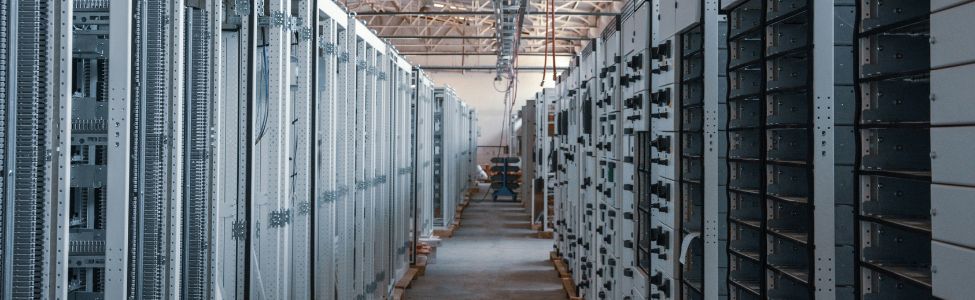
Chicagos universities, civic organizations, and business leaders are working to establish the city as a major Midwest center for artificial intelligence. New startup programs, university partnerships, and technology events are attracting attention and investment to the region. But that growth is unfolding alongside a more contentious trend: the rapid expansion of data centers across northern Illinois. Data centers support artificial intelligence, cloud computing, streaming, data storage, and other digital services. They are not exclusively AI facilities, but the growth of AI is accelerating demand for the enormous computing capacity they provide and for the electricity needed to run them.
Data centers support artificial intelligence, cloud computing, streaming, data storage, and other digital services. They are not exclusively AI facilities, but the growth of AI is accelerating demand for the enormous computing capacity they provide—and for the electricity needed to run them.
That demand is now at the center of a debate over rising power costs, infrastructure investment, and whether households should be responsible for expenses created by some of the region’s largest electricity users.
ComEd has reported that more than 80 data centers operate within its northern Illinois service territory, with additional projects under consideration.
The expansion comes as prices have risen sharply in the capacity market administered by PJM Interconnection, the regional grid operator serving northern Illinois and portions of 12 other states and the District of Columbia.
Unlike charges for electricity already consumed, capacity payments are intended to ensure that enough generating resources will be available in the future, particularly during periods of peak demand.
PJM’s capacity price rose from $28.92 per megawatt-day for the 2024–2025 delivery year to $329.17 per megawatt-day for 2026–2027. That represents an increase of more than 1,000%.
Data-center demand is not the only factor affecting the market. Power-plant retirements, delays in connecting replacement generation to the grid, market rules, and broader growth in electricity use also influence prices. Nevertheless, large data centers have become an important part of the region’s demand forecast.
he Natural Resources Defense Council estimates that rapid data-center growth could add $21.4 billion in cumulative capacity costs for customers in ComEd’s northern Illinois territory from 2028 through 2033. That estimate is part of a projected $163 billion increase across the broader PJM region.
According to the NRDC analysis, the added costs could eventually increase the average affected household’s electric bill by approximately $70 per month.
Those figures are projections, not guaranteed increases. The ultimate effect will depend on how many proposed data centers are completed, how much electricity they consume, how quickly new generation becomes available, and whether regulators change the way infrastructure and capacity costs are assigned.
ComEd says it does not profit from increases in wholesale electricity-supply prices.
The utility delivers electricity to customers, but supply and capacity costs are determined separately and passed through without a ComEd markup. The Citizens Utility Board, an Illinois consumer watchdog, has supported that specific distinction while continuing to challenge some of ComEd’s delivery-rate requests before state regulators.
That distinction does not make higher bills less painful for consumers, but it helps explain where the costs originate. A residential bill can include separate charges for electricity supply, capacity, transmission, taxes, and ComEd’s local delivery system.
ComEd has also introduced additional financial requirements for large new power users. Data-center developers can be required to make long-term commitments backed by deposits or letters of credit when they request substantial electrical capacity.
The goal is to prevent other customers from being left with infrastructure costs if a developer reserves capacity but later scales back or abandons the project.
Those protections address the risk created by projects that never materialize. They do not completely resolve the larger question of who should finance new generation, transmission lines, substations, and other infrastructure if data-center electricity use continues to grow.
The debate is especially visible in Aurora, which has become one of northern Illinois’s most prominent data-center locations.
On September 25, 2025, Aurora imposed a 180-day moratorium on new data-center and warehouse developments. The temporary pause gave city officials time to create standards addressing the distinctive effects of data centers, which had previously been treated under broader warehouse classifications.
The Aurora City Council approved a new regulatory framework on March 24, 2026, with the moratorium concluding the following day.
The new rules formally distinguish data centers from conventional warehouses and require proposed developments to undergo a more extensive public review. Applicants must provide detailed information about their anticipated operations, including:
New projects also require a development agreement and City Council review.
The rules followed concerns about the effect of industrial facilities on surrounding neighborhoods. Residents near existing data centers have reported persistent humming and vibration, illustrating that the local effects extend beyond electricity prices.
Because the regulations primarily apply to future developments, they may offer limited immediate relief to people living near facilities already in operation. Nevertheless, Aurora’s approach establishes clearer expectations for developers and gives residents a more direct role in the approval process.
The regulations also reflect a trade-off facing municipalities across the region. Data centers can bring construction activity, property-tax revenue, and technology investment, but they can also consume substantial amounts of electricity and water while generating relatively few permanent jobs compared with their physical size and infrastructure requirements.
The infrastructure controversy has not halted efforts to expand Chicago’s AI and technology economy.
The University of Chicago’s Polsky Center for Entrepreneurship and Innovation and its Data Science Institute have announced a partnership with AI Research Commons, Microsoft, and NVIDIA. The initiative is designed to provide resources such as technical assistance, cloud-computing support, funding opportunities, and mentorship to early-stage AI companies emerging from Midwestern research institutions.
Participating institutions include Northwestern University, Purdue University, and the University of Illinois. The initiative builds on the University of Chicago’s existing Transform accelerator, which supports startups and provides workspace on the university’s South Side campus.
P33, a civic nonprofit that has promoted Chicago as a leading technology hub, also operates programs intended to attract investment and address disparities in startup funding. Its TechRise initiative provides non-dilutive grants and support to Black and Latino technology founders in Chicago.
The region’s technology network was also on display during TechChicago Week, held July 20–23, 2026. Programming organized by groups including innovation hub 1871, P33, and the Illinois Economic Development Corporation included events focused on quantum computing and opportunities connecting fintech and climate-tech founders with investors and industry partners.
These programs demonstrate that Chicago’s AI strategy is about more than data centers. It also encompasses university research, startup formation, workforce development, and access to capital.
But the connection between the digital economy and its physical infrastructure cannot be ignored. AI software may be developed in a university laboratory or startup office, but training and operating advanced systems ultimately require servers, cooling equipment, electrical connections, and reliable power.
Chicago and northern Illinois do not face a simple choice between embracing artificial intelligence and rejecting it. The more difficult question is how the region can capture the economic benefits of AI and data-center investment without shifting an unfair share of the associated costs to households and small businesses.
Data centers are not solely responsible for rising electricity prices, and not every data center is dedicated to AI. But their rapid growth is adding substantial new demand at a time when the regional electricity market is already under pressure.
Aurora’s response shows how one community is trying to regain control over the local effects. ComEd’s financial requirements for large users represent another attempt to prevent speculative projects from leaving ordinary customers with the bill. Consumer and environmental advocates, meanwhile, continue to call for broader reforms that would assign more of the cost directly to the companies creating the demand.
Chicago’s AI investment story is real. So is the infrastructure burden accompanying it.
An honest assessment of the region’s ambitions must therefore consider both sides: who receives the investment and opportunity, who pays for the electricity and infrastructure, and whether the rules ensure that the largest new power users bear the costs they create.